August 3, 2026
Every year, organisations roll out beautifully designed performance appraisal systems. There are detailed forms, competency matrices, SMART objectives, KPIs, development plans, achievements and enough text to convince anyone that this is an objective, evidence-based process. Employees spend hours documenting every achievement, every initiative, and sometimes it feels as though they are writing a report on everything from their daily activities to planning a mission to the moon.
A lot of numbers are quoted and metrics are explained. Beautiful paragraphs are written. The result is often a perfectly crafted salad of words.
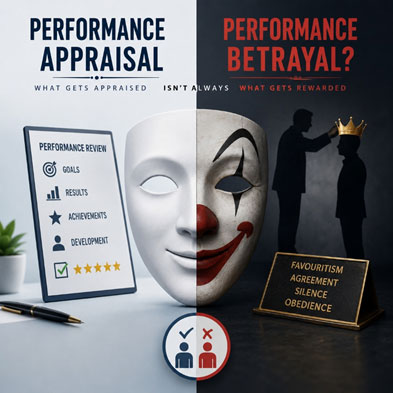
Yet, deep down, almost everyone involved knows an uncomfortable truth. The employee filling out the form knows it. The manager reviewing it often knows it. The appraisal was already decided long before the process even began.
In many organizations, the elaborate documentation merely creates an illusion of objectivity.
The real decision is often shaped not by facts, but by the perceptions of a select few. Those perceptions are reinforced by workplace informers and loyalists (!) who echo what leaders want to hear, while forgetting that the very same informers may be playing both sides.
The uncomfortable question is:
What really gets rewarded?
Is it competence, consistent performance, integrity, loyalty, etc.?
Or is it something else?
Unfortunately, speaking up, or challenging poor decisions respectfully is sometimes remembered far longer than months of outstanding work.
To be fair, deserving people do get promoted. And when they do, their colleagues usually acknowledge it without hesitation saying - "They earned it".
Those moments build organisational trust. But they are often overshadowed by cases where promotions appear disconnected from contribution. We've all seen employees who seem to leap ahead repeatedly, receiving one promotion after another, sometimes 3 promotions within 3 years, even in organizations where everyone else is told that 3 years is the minimum period before promotion can even be considered!
People notice.
Employees are remarkably good at identifying what is genuinely rewarded.
And once they discover the behaviours that lead to success, they naturally begin to imitate those behaviours. Not because they lack values, but because the system taught them what matters.
When performance appraisal decisions are built on selective narratives instead of objective evidence, the organisation doesn't just risk making the wrong choice. It risks losing trust. That is when organisational culture begins to shift. Culture is not built through posters, town halls or vision statements. Culture is built by what organisations celebrate, tolerate and promote.
Does your performance appraisal process strengthen organisational culture and reward merit, or is it simply an annual exercise in futility?