August 5, 2026
World Breastfeeding Week (WBW) is observed globally every year from 1–7 August to promote breastfeeding as a fundamental strategy for improving maternal and child health. In India, World Breastfeeding Week 2026 is being commemorated by the Ministry of Women and Child Development (MoWCD) in collaboration with the Ministry of Health and Family Welfare and other stakeholders. The 2026 theme, "Breastfeeding for a Sustainable Start in Life: Strengthen What Works," emphasizes building upon proven interventions that successfully improve breastfeeding practices. Rather than identifying new strategies, the campaign focuses on tracking progress, evaluating the impact of existing programmes, and expanding evidence-based interventions that have demonstrated measurable improvements in breastfeeding outcomes. The campaign strongly advocates initiating breastfeeding within the first hour after birth, exclusive breastfeeding for the first six months of life, and continued breastfeeding up to two years of age and beyond, together with the introduction of appropriate complementary foods after six months. Early initiation allows newborns to receive colostrum, often referred to as the baby's first natural vaccine, because it is rich in immunoglobulins, growth factors, and essential nutrients that provide passive immunity and protect against infections during the neonatal period.
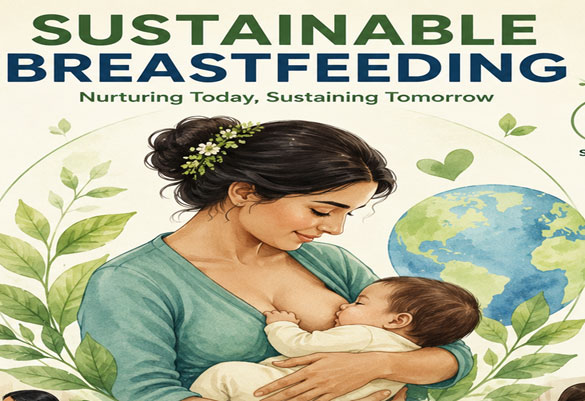
Breastfeeding provides substantial health benefits for both infants and mothers. For infants, breast milk supplies complete nutrition during the first six months, enhances cognitive development, strengthens immunity, and reduces the risk of diarrhoeal diseases, respiratory infections, obesity, and several chronic illnesses later in life. For mothers, breastfeeding promotes uterine involution, reduces postpartum haemorrhage, assists in birth spacing through lactational amenorrhoea, and lowers the long-term risk of breast cancer, ovarian cancer, type 2 diabetes mellitus, and postpartum depression. These benefits collectively contribute to healthier families, reduced healthcare costs, and improved population health.
A key message of the 2026 World Breastfeeding Week is the importance of strengthening the "Warm Chain of Support," a coordinated network of assistance extending from pregnancy through infancy. This approach encourages governments, healthcare systems, workplaces, civil society organizations, communities, and families to work together in creating environments that enable mothers to initiate and continue breastfeeding successfully. Continuous support from trained health professionals, family members, employers, and community workers is essential for overcoming breastfeeding challenges and sustaining optimal infant feeding practices. Evidence consistently demonstrates that the challenge is not identifying effective breastfeeding interventions but investing sufficiently to implement them at scale. Several interventions have been proven to significantly improve breastfeeding outcomes.
Skilled Infant and Young Child Feeding (IYCF) Counselling
Professional counselling delivered through health facilities, community health workers, and household visits is among the most effective interventions for improving breastfeeding practices. Skilled counselling helps mothers address common concerns such as poor latch, perceived insufficient milk, and breastfeeding difficulties while reinforcing confidence and correct feeding techniques. Integrated counselling and education programs significantly improve exclusive breastfeeding rates, demonstrating that combined antenatal and postnatal support helps mothers feed their babies safely for the first six months. Evidence from broader reviews highlights that structured guidance lowers infection risks and boosts maternal confidence.
Baby-Friendly Hospital Initiative (BFHI)
The Baby-Friendly Hospital Initiative (BFHI) promotes evidence-based maternity care through the Ten Steps to Successful Breastfeeding, ensuring that mothers receive appropriate guidance immediately after childbirth. These practices include skin-to-skin contact, early initiation of breastfeeding, rooming-in, and avoidance of unnecessary formula supplementation. Studies involving 15,096 newborns found that implementation of BFHI resulted in a 45% increase in exclusive breastfeeding at six months and a 26% increase in continued breastfeeding, highlighting the critical role of healthcare institutions in supporting breastfeeding.
National Mass Media Campaigns
Mass media campaigns play an important role in improving public awareness, correcting misconceptions, and normalizing breastfeeding within society. When television, radio, digital media, and print campaigns are combined with community mobilization and professional counselling, they reinforce positive breastfeeding behaviours. A systematic review of 16 studies demonstrated that integrated media interventions increased exclusive breastfeeding by approximately 17%, indicating that public education complements individual counselling efforts.
Implementation of the International Code of Marketing of Breast-milk Substitutes
The International Code of Marketing of Breast-milk Substitutes protects mothers from inappropriate marketing practices that discourage breastfeeding. Countries that have implemented legislation closely aligned with the Code report substantially higher breastfeeding rates. On average, exclusive breastfeeding reaches approximately 54% in countries with strong legal implementation, compared with only 24% in countries lacking such protections. Effective enforcement of the Code helps ensure that breastfeeding decisions are based on accurate health information rather than commercial promotion.
Paid Maternity Leave
Paid maternity leave provides mothers with sufficient time to establish breastfeeding without financial hardship or pressure to return to work prematurely. Evidence from a systematic review of 35 studies conducted in low- and middle-income countries found that paid maternity leave increased exclusive breastfeeding by approximately 52%. Supportive maternity protection policies therefore represent one of the most effective structural interventions for improving breastfeeding outcomes.
Workplace Breastfeeding Support
Returning to work is one of the major reasons mothers discontinue exclusive breastfeeding. Supportive workplace policies—including paid breastfeeding breaks, flexible work arrangements, lactation rooms, and facilities for expressing and storing breast milk—enable mothers to continue breastfeeding after resuming employment. Studies consistently demonstrate that workplaces implementing breastfeeding-friendly policies achieve significantly higher rates of exclusive and continued breastfeeding, benefiting both employees and employers through improved maternal and child health and reduced absenteeism.
The theme "Breastfeeding for a Sustainable Start in Life: Strengthen What Works" reinforces that effective strategies to improve breastfeeding are already well established. The priority is to strengthen existing programmes, expand proven interventions, invest in supportive policies, and ensure that every mother receives continuous assistance through the Warm Chain of Support. By promoting early initiation, exclusive breastfeeding for the first six months, continued breastfeeding alongside complementary feeding, and evidence-based policy interventions, countries can substantially improve maternal and child health while contributing to sustainable development goals and healthier future generations.