August 6, 2026
Snakebite has become a major public-health emergency in India, claiming tens of thousands of lives every year and leaving many people with permanent disability. As Karnataka grapples with having India’s second-highest rate in snakebite fatalities for the second consecutive year, researchers at the Indian Institute of Science (IISc) are warning that India’s standard medical response is dangerously outdated.
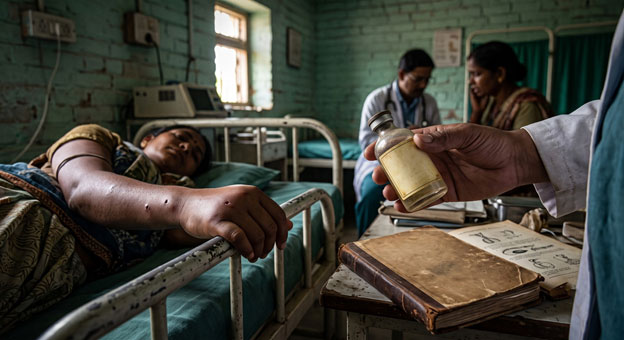
AI-generated image
A hidden public health emergency
The most recent nationwide study cited by Ajinkya Kishore Unawane, a venom researcher at the Indian Institute of Science (IISc), Bengaluru, was conducted by Suraweera and colleagues in 2019, estimates that about 58,000 people die every year in India from venomous snakebites. “Three times that number of people suffer with lifelong morbidity or amputations,” he added. Most victims are primary breadwinners for their families. These figures come from a peer-reviewed scientific journal, yet they still underestimate the real burden because they capture only cases that reach hospitals and are formally recorded.
Globally, Unawane points out, “almost 5.1 million envenomations happen,” including bites from venomous and non-venomous snakes. The World Health Organisation (WHO) has officially classified snakebite as a “neglected tropical disease,” reflecting how serious the problem is and how little attention it receives compared to other illnesses. He stressed that India has been called a “global snake bite capital,” yet the country continues to lose roughly as many people to snakebite each year as it lost to Covid-19 in some recent years, without comparable public concern.
Under-reporting remains a central problem. In many remote and rural areas, people still turn to “babas, mantrik tantrik treatments, faith healers and traditional healers,” rather than going to hospitals, especially when they believe in myths and fear hospitals. Deaths and complications from these unrecorded cases never appear in official statistics, meaning the real number of snakebite deaths “we never know.”
India’s snakes and the limits of treatment
India has an extraordinary diversity of snakes, with roughly 360-370 species found across the country. Of these, around 60 venomous species are “medically relevant,” meaning their bites can cause serious illness or death in humans. However, India’s current anti-venom medicines are designed only for the so-called “big four” snakes: cobras, kraits, saw-scaled vipers, and Russell’s vipers, which are widespread and cause much of the known snakebite burden.
“At the moment, anti-venom… is the only approved treatment to deal with any venomous snake bite,” Unawane explained, but “whatever anti-venom we are currently using… is almost a 115-year-old procedure or the protocol we are currently following.” This anti-venom is produced by injecting small doses of snake venom into horses, collecting the antibodies the animals produce, and turning them into vials of medicine. All of the venom used for this process in India currently comes from a single tribal community: the Irula people near Mahabalipuram in Tamil Nadu, who catch venomous snakes in their local area, “milk” their venom, and sell it to anti-venom manufacturers.
The scientific problem, Unawane emphasises, is that India has 10 distinct biogeographic regions, each with different climates and ecologies, and that the same snake species can produce different venoms across regions. As a result, the anti-venom made from snakes in one locality may not work equally well against snakes of the same species living in very different environments elsewhere.
His laboratory’s work has shown that when venom samples are collected from different corners of the country and tested, the anti-venom does not always neutralise them effectively. As a result, doctors sometimes have to give extremely high doses, “50, 100, 200, 400 vials of anti-venoms,” and even then, outcomes may be uncertain. High doses can trigger side effects such as allergic reactions, anaphylaxis, or unusual long-term problems, including loss of smell or itchiness when eating certain vegetables, although Unawane notes these are rare.
Venom also changes over a snake’s lifetime. In studies from his own research on Russell’s viper, he found “a drastic change” between venom from juveniles and adults, with juvenile venom showing “tremendously high potency compared to the adult one.” Because Irula collectors follow wildlife-protection rules and guidelines, they mainly collect from big adult snakes for venom, while real-world bites happen at “any stage” of a snake’s life. This mismatch further complicates treatment and can contribute to cases where anti-venom seems to “work sometimes, or fail.”
Beyond the big four, many other venomous species, such as the king cobra, hump-nosed pit viper and Malabar pit viper found in Karnataka, can cause severe envenomation in their local ranges. At present, no specific anti-venom exists for these “neglected yet medically important snakes,” so hospitals often still use the big-four anti-venom, hoping for partial cross-reactivity.
Why monsoon puts farmers at risk
Snakebite cases in Karnataka and other parts of India often surge during the monsoon months, especially among farmers, and Unawane explains that this is not a coincidence. Cobras, for example, mate around March to April, and the female can lay “7 to 40 eggs.” These eggs typically hatch in “another 80 to 120 days,” meaning that just before or during the monsoon, “the young ones will come out.”
Peak harvesting time for many crops also coincides with the start of the monsoon. At that point, in fields, grasslands, and areas near human settlements, species like cobras and Russell’s vipers appear among people, especially young snakes. “These young ones will be everywhere,” he says, and this ecological overlap increases the likelihood of human–snake encounters and bites. Monsoon rains can also force snakes out of their usual hiding places, bringing them into contact with farmers working barefoot or with minimal protective gear.
Myths, misinformation and awareness
Alongside biology and medicine, Unawane stresses the importance of social attitudes and awareness. In Indian religious and cultural traditions across communities, snakes have a complex image: they are worshipped in some contexts yet associated with fear and danger in others. This history, he argues, “people have too many myths in their mind carried forward from generation to generation.”
He offers a striking line: “The only difference between beauty and scary is knowledge. The more we educate the people… the more aggressive they become towards snakes and kill them, but we should not.” Not all snakes are venomous, and many, such as the Indian rat snake, are in fact “farmers’ friends” because they eat rats. Rats are a “worst nightmare for any farmer,” and Unawane noted that “one fifth of the grain which is produced by India is damaged by only,” due to their high reproductive rate.
What to do when a snake bites
For ordinary people, the most crucial steps after a suspected snakebite are rapid transport to a hospital and correct first aid. Unawane emphasised timing: “After envenomation, how fast the victim reaches the hospital, that matters.” This is particularly vital for bites from elapids such as cobras and kraits, whose neurotoxic venom can paralyse the muscles needed for breathing, often necessitating ventilation. Many such bites occur in remote rural areas where Primary Health Centres (PHCs) lack ventilators and other equipment.
He cautions against common but dangerous tourniquet practices, such as using tight bands to restrict blood flow. People often tie a tourniquet “tightly” while rushing to the hospital, then remove it suddenly. Using a railway-crossing analogy, he explains that if blood flow is completely blocked, venom accumulates like traffic at a closed gate; later, when the gate opens, “whatever venom accumulated… like a shooting dose gets into the heart or nervous system, resulting in death.”
Instead, if a tourniquet is used, he advises applying it “very gently, like with an ample amount of pressure,” and intermittently loosening and re-tying it every 20 to 25 minutes while heading to the hospital, so blood flow is partially maintained rather than fully blocked. At the hospital, doctors will look for specific symptoms, and “unfortunately, we have only one drug available… that is anti-venom,” which they will administer according to protocols.
Identifying the snake species can help doctors, but patients and families should not risk their lives trying to catch or kill the snake. Instead, Unawane mentions that there are “certain apps like the Serpa app, Snake Hub app” that can help identify snakes from photographs for better treatment.
Unawane also highlights gaps in snakebite data and surveillance. Studies that rely on hospital records often cover only a subset of facilities: for example, a researcher might obtain data from 60 to 70 hospitals in Karnataka that frequently see snakebite cases, while missing many others.
Snakebite is preventable and treatable if people have accurate knowledge, act quickly, and trust scientific medicine. In a country that is a “global snake bite capital,” knowledge of snakes, venom, antivenom, and first aid can make the difference between life and death.