September 8, 2026
In the Months of August, September and October we have many Marian feasts being celebrated and we see during this season many people holding novenas in honour of Mother Mary and going on pilgrimage to Marian shrines to experience the divine. Though we do not usually celebrate the birthdays of the saints, instead, we celebrate the day they died; because that is the day they were born into the joys of heaven. But the birthday of Mary, our Blessed Mother, is an exception. We do celebrate her birthday (Monthi Fest or Arogya Mathe) because she came into this world full of grace and she was to be the mother of Jesus. When Mary was born, she brought great joy to the world. Her birth meant that soon Jesus, the Son of peace and justice, would appear. Mary was the wonderful human being whose privilege it was to bring the Lord Jesus to all people.
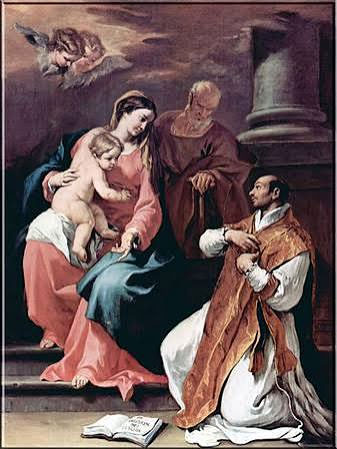
Coming to St Ignatius of Loyola, Mary has a very central place in the life of St Ignatius. She appears at very significant and crucial moments of his spiritual journey. In the beginning it seemed as if Ignatius had a pious devotion to the Blessed Virgin Mary. The first time that Ignatius mentions her in his Autobiography (AB) is when he has made his discernment through a long process of consolations and desolations. He decides to follow Christ imitating the saints. To confirm him in his decision, "one night while he was awake, he saw clearly an image of Mother Mary with the holy Child Jesus. From this sight he received for a considerable time very great consolation, and he was left with such loathing for his whole past life….” (AB no.10).
To continue and deepen his process of conversion Ignatius, "he set himself very diligently to write a book with redink for the words of Christ, blue ink for those of Our Lady." (AB no.11). Very unconsciously Ignatius begins to place Christ and Mary almost on the same plane. He will carry this notebook everywhere he goes. His notes will be the source and inspiration of his personal conversion and will help him bring others onto the same pathway to God.
He leaves his family home and sets out to live the life of a pilgrim. His first stop is at the shrine of Our Lady of Aranzazu. Here "he prayed that he might gain fresh strength for his journey" (AB no.13). At this time too he used a part of the money that was in his possession "for a statue of Our Lady that was in ill repair, so it could be repaired and handsomely adorned" (AB no.13).
At one point, Ignatius' pious devotion to the Blessed Virgin caused him to consider murdering the Moor who questioned the virginity of Mary. The Moor's belief "caused discontent in Ignatius' soul, as it seemed that he had not done his duty. . . " (AB no.15). His final act of piety was at the shrine of Our Lady of Montserrat. Here "he decided to keep a vigil of arms one whole night. . . He had resolved to lay aside his garments and to don the armour of Christ" (AB no.17).
From now on Ignatius' spiritual life and his devotion to Mother Mary deepens and matures. He now walks the mystical path. At Manresa, Ignatius begins to see Our Lady in the same way as the humanity of Christ. "The form that appeared to him was like a white body, neither very large nor very small, but he did not see any distinction of members" (AB no. 29). In the humanity of Christ, Ignatius sees the whole Being of God (Journal February 27, 1544). It seems that Ignatius experienced the very Being and Essence of God in Mother Mary. In fact, Ignatius firmly believes that Mary forms an essential part of Jesus. "At the consecration at Mass, Mary showed that her flesh was in that of her Son, with such great light that I cannot write about it." (says in his Journal February 15, 1544).
From Manresa Ignatius' devotion to Mary becomes the occasion of his many mystical graces. "One day while saying the Office of Our Lady. . . his understanding began to be elevated as though he saw the Most Holy Trinity" (AB no. 28). His experience of La Storta when he was placed with the Son was in answer to the prayer that he made to Mary while he was preparing to celebrate his First Mass. "Praying Our Lady to deign to place him with her Son. One day, a few miles before reaching Rome, he was at prayer in a church and experienced such a change in his soul and saw so clearly that God the Father placed him with Christ his Son that he would not doubt it" (AB no. 96).
Ignatius' mystical life climaxes into the very Being and Essence of God. On March 6, 1544 he notes in his Journal: "I felt and saw, not obscurely, but clearly and very clearly the very Being and Essence of God, under the figure of a sphere, slightly larger than the appearance of the sun." On February 15, 1544 Ignatius makes it clear that Mary is the channel of all the graces that he has received in his life: "While preparing the altar, and after vesting, and during the Mass, very intense interior movements, and many and intense tears and sobbing, with frequent loss of speech, and also after the end of Mass, and for long periods during Mass, preparing and afterwards, the clear view of our Lady, very propitious before the Father, to the Son, and at the consecration, I could not help feeling and seeing her, as though she were a part, or the doorway of all the graces I felt in my soul."
The spirit of Mary seems to be the same as that of Jesus and the Father and it is becoming one with that spirit that Ignatius teaches us to make the triple colloquy. "I prayed to Our Lady, and then to her Son and to the Father, to give me their spirit" (February 11, 1544). Ignatius will introduce this way of praying at crucial points of the Spiritual Exercises (Retreat) when he invites the Retreatant to use the Triple Colloquy to obtain the graces that are so significant and, in some ways, foundational. Mary in the Spiritual Exercises is placed before the Retreatant as being part of the Trinity and the Heavenly Court.
To conclude therefore, even today, if we have Mary, we have Jesus. Whoever is very devoted to her is very close to the heart of Jesus. On September 8, we celebrate and proclaim with joy to the whole world the birth of the Blessed Virgin Mary. We can always turn to Mary for help. She is very close to the heart of Jesus. What special intention can I ask her today? Today, when we do not find time for prayer in our personal as well as family life, it could be apt that I ask for the gift of prayer in my personal life and in the life of my family? It is by being a man and woman of prayer or by being prayerful men and women we could be the better pilgrims of hope in today’s world. Mary is the true model of prayer and a genuine pilgrim where she treasured all things in her heart (Lk 2:51) and remained obedient to God’s will.
Happy Feast of the Nativity of the Blessed Virgin Mary.