September 18, 2026
Recently, I attended an event where I reached well before the scheduled start time and was ready for the programme to begin. As the scheduled time approached, more people began trickling in. Those who had arrived early were asked to move forward to accommodate the latecomers, while participants and organisers kept adjusting the seating. Sadly, this seems to have become the norm rather than the exception at many events.
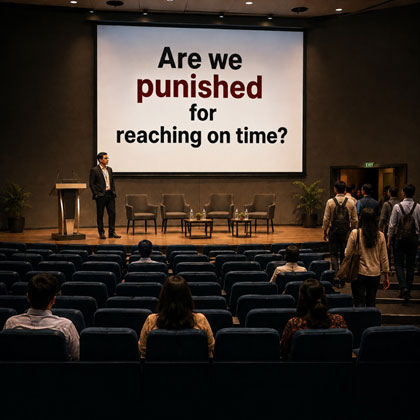
The speaker was ready, the arrangements were in place and many participants were seated, but the programme couldn't start because we were waiting for those who were still arriving.
And wait we did for 45 minutes!
The delay had a domino effect. The programme stretched beyond its scheduled duration, forcing some participants to leave for their offices at the scheduled end time. What should have been a well-organised event ended with an unsettled atmosphere, simply because the programme did not start when it was supposed to.
But here comes the funny part.
The event instructions specifically asked those who reached early to park in an area some distance away from the auditorium. Latecomers, on the other hand, could park right inside the auditorium campus!
So, the question is: Are we inadvertently incentivising people to arrive late?
Of course, genuine emergencies and unavoidable delays happen. This is not about those situations. It is about a culture where being late is routinely accommodated while punctuality is simply taken for granted.
Perhaps we need to rethink how we organise events. Starting on time is not merely about discipline. It is about respecting the time of speakers, organisers and most importantly, those who made the effort to arrive on time.
Punctuality may not need a reward, but latecomers shouldn't be rewarded with convenience while punctual people are asked to adjust.
If everyone is expected to wait for those who are late, aren’t we inadvertently rewarding the very behaviour we should be discouraging?