September 23, 2026
No media reported it. No influencers flocked to this medieval pilgrim town of Lourdes, carrying a change of clothes for every REEL and, of course, their phones. No politicians created the kind of trouble they usually do, and no awards or accolades were bestowed upon the three Mangaloreans from Kundapur.I don’t know why, but the moment people from coastal Karnataka cross the borders of the state, everyone seems to become a Mangalorean. Not that we aren’t proud of the rapidly growing or should I say, rapidly deteriorating city. But if everyone from Mangalore all the way to Honnavar starts calling themselves Mangalorean, I feel we are doing an injustice to the many wonderful places that lie between the two.
The three Indians I was talking about were myself, my wife and my little son.
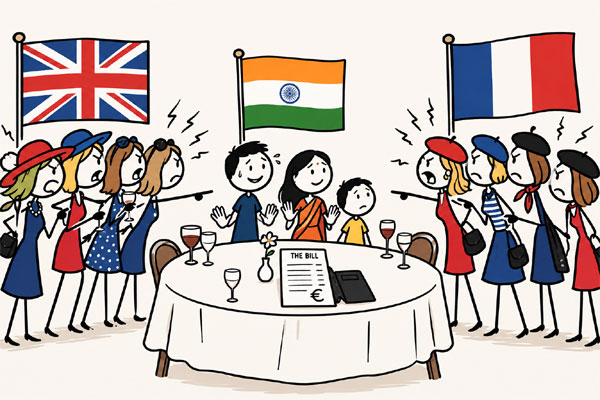
Fate had put us in a tight spot that day, and fortunately, diplomacy won the day, along with a little light-hearted serious sarcasm. In a world already plunged and falling in love in warfare, it certainly didn't need two once-mighty powers, perhaps not quite so mighty anymore, meddling in another Hundred Years' War."
Like all wars, no one knew the actual cause and, in this case, neither the British nor the French. Caught in the middle of the two warring parties, only India, the three of us knew what the war was really about.
It was not about oil.
Not about land.
Not about religion and definitely not about God.
Not about precious minerals.
Not about self-defence.
Not about power.
Not about the colour of skin.
Not about gender.
It was about a cause absolutely not worth fighting for in today’s highly materialistic world. Not even a penny’s worth - Money! And, according to the two warring parties, ETHICS, a trait conveniently moulded according to circumstance and convenience.
We were sitting at a table between the cash counter and a long table occupied by, I would say, well-behaved but rather loud English women. From where we sat, we could clearly see why the French owners of the restaurant, also women, were getting increasingly pissed off.
The English delegation, consisting of around thirteen rather elegant ladies, insisted on paying individually. The French women, however, were telling them, to pay the bill first and then divide the amount among themselves.
“Oh, come on! How difficult is it to divide it once you get back to your hotel?” the younger French woman blurted out.
“Oh, come on! How difficult is it to do the transaction according to what we have eaten?” the English lady retorted.
“It takes time to punch it all in,” the older French lady replied.
“Haah! There are only three more people waiting,” the English lady pointed out, gesturing at us.
“Well, in that case, let me come back to you once I serve them,” the French woman retorted.
Clearly the talks had broken down and we were now forced into this mindless act of aggression.
To dodge the situation, as most well-behaved Indians do, I asked, “What is the best dish in your restaurant?”
I had already received my wife’s standard answer to the eternal restaurant question “What shall we order?” – “Anything is fine.”, a phrase I dread.
“Well, Monsieur, everything is good. Do you want everything?” She instantly regretted it.
“Sorry, Madame.” For some reason she directed her reply towards my wife who, was sitting opposite me. She looked directly at my wife, then nodded towards the other table, before making a face that needed no translation.
“Try the cassoulet.” She explained that it was a southern dish of slow-cooked pork and white beans. Anything with pork in it had to be good.
We ordered one of those, along with a few other dishes, including a questionable pizza.
By then, the English team had ordered a bottle of wine and were sipping it while doing the math. The French were fuming and making faces.
It was cold. Probably colder than the Cold War!
And this, as we soon realized, was enough to start a war.
The French waiter, an old man, was now throwing his hands up in frustration. So, we got up and walked towards the counter. Beside it, neatly arranged in a glass display case, were four French delicacies.
This was the standard Indian diversion tactic: when faced with a difficult problem, why solve it when you can simply distract everyone with something more interesting?
Usually, it works on Indians, especially when played by the politicians. But somehow here, it backfired on us.
We enquired about each one, and the French lady explained them so enthusiastically that we ended up ordering all four desserts!
“The French can bake,” I exclaimed.
“Apparently, they can’t account for thirteen meals,” whispered the loud English lady, loud enough for the man across the street to hear.
We should have gone back to our seats and enjoyed the rest of our meal. But having gained considerable experience and attention, though strictly local, in stopping wars over the last few years, and armed with our silent, probably non-existent yet highly visible chocolate diplomacy, we thought it was time for the Indians to step in and solve some serious world issues.
“Ladies,” I addressed both the warring parties. “What are you doing?”
I paused- it was almost like I forgot my prepared speech.
My wife took over.
“It is simple math. I don’t know why you are taking it so much to heart.”
The French got riled up. “Well, these stubborn British have shared some drinks. Some have eaten more and some less. We don’t know who has eaten what. How are we supposed to break it down?”
“Just get the full check and go around the table until you collect the full amount,” my wife replied.
“They are good at dividing and conquering,” I added sarcastically. “Aren’t you ladies?”
I smiled nervously. The English weren’t amused.
All these lovely ladies had probably heard about British colonialism from their elders at home, or perhaps had some relative who had once served in the most sought after Indian Civil Services.
“Well, you guys are supposedly good at maths, and you’re also experts at dividing yourselves into groups and then fighting among yourselves. So why don’t you do something?” one of the British ladies responded.
They knew their history and our present too.
The French were not ready to buckle under third-nation pressure. They wanted the British and the Indians to follow their way of doing things, a tactic they had mastered rather miserably during their days of colonialism.
“Give me the machine,” I said, taking control of the situation. “Give me the check as well. I will go around the table and collect the money.”
And so, I did.
I went around the English table, collected the money and even told the ladies to leave a generous tip.
I went around the English table with the card machine, like a tax collector. For the first time in recorded history, an Indian was collecting revenue from the British, and no one was calling it "administrative reform."
Somewhere in Kundapur, my great grandfather must have turned in his grave and smiled.
The French, in an act of great forgiveness, took the bottle of wine off the bill.
Everybody was happy. There was even a round of applause for the Indians who had done it.
Finally, we had become real Vishwa Gurus!
However, it came at a price. Those four desserts were three too many for us. And we had to share them with the British, who “shared the pudding” and went on their merry way.
The French didn’t mind and did not think about taking it off our bill.
After all, peace has its own rewards.