Reminiscing Fr Faustine Corti, SJ, The Missionary of Naravi, on His Death Centenary

October 8, 2026

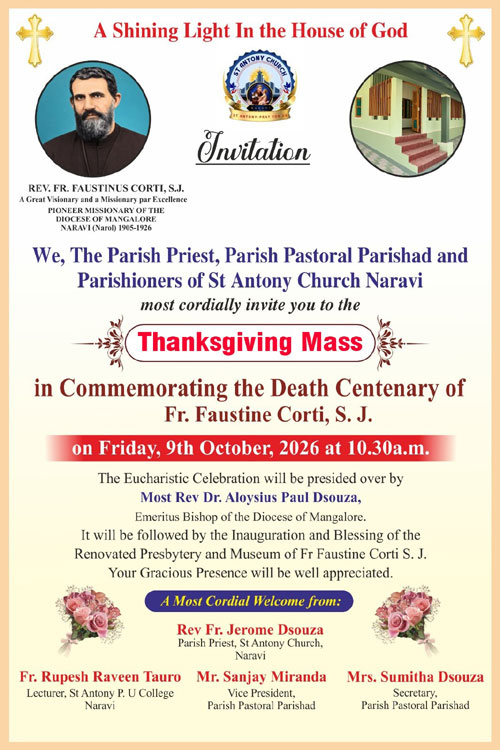
Exactly a hundred years ago, a Jesuit priest, suffering with fever, breathed his last on Saturday, 9th October 1926. That Jesuit was Fr Faustine Corti, SJ — a missionary from Switzerland who, for his service, earned the affectionate names — “Mansere Guru” (the priest of Pariahs or the Guru of Harijans) and “Living God” from the poor of Naravi and the hills around it.
An unlikely calling

Born on 5 November 1856 in Curio, Switzerland as the ninth child of Francis and Lucy, Corti lost his mother at eleven, and his father — needing him at home in his old age — refused to let him join the Jesuits, until he secretly slipped out and joined the order in 1878. Word of the Jesuit mission in far-off Mangalore reached him during his formation, and never left him. He reached Mangalore in 1884, and spent his first two years at Jeppu, learning and teaching Tulu and Konkani. He was ordained a priest in 1891 and spent a decade teaching mathematics at St Aloysius College — steady, respectable work that gave him nothing but restlessness for the mission field.

To Naravi, and a change of heart

His chance came in 1905, when he was sent to Naravi, a remote town in the foothills of the Western Ghats some 70 km from Mangalore. Corti’s earliest strategy was similar to the famed missionary Robert de Nobili’s — to immerse himself among the people, expecting a trickling-down effect. After Two years, he was happy to see the fruit of his labour. Corti turned to the Pariahs and the people who are the region’s most marginalised communities, and found his true ministry there.

A life stripped bare

Corti lived in the same conditions as they did — his hut had no bed, table or chair, except a mat on which to sit, a few medicine bottles and, always, people around him. He fed his own cooked rice to children who wandered in at mealtime, and served food on old newspapers — for want of plates. He once even gave his cassock to clothe a Pariah man who had none. When his Bishop, surprised at his poverty, asked what he needed, Corti’s answer was simply — an umbrella!

He taught catechism so that the people would know about the Christ and the Church. When the dreaded smallpox broke out in the Dalit settlement at Ramara Guttu, he lived in their huts and nursed them through the plague, rather than taking a safe distance.

Kempi- His horse

No story of him can be complete without Kempi, his horse — so devoted that she once launched him — and herself — into a swollen river to outpace those who against Fr Corti — just in time for him to reach the court and win a case for a Dalit client. She avoided a pit dug to kill them both, on another occasion. 

A fight with the abusers, and recognition

Corti’s fight for the rights of the Dalits made him an enemy of others. He fought for the rights of the Dalits. For his work for the Dalits, the government awarded him the Kaisar-i-Hind Medal (sources differ on the year — 1911 and 1918 are both cited), but the recognition is well-documented. His circuit widened to include Moodbidri, Perady, Shirthady, Alangar, Arva, Badyar, Venor, Madanthyar, Ujire, Penchar, Nellikar and Homapadavu. In 1920, still based out of Naravi, he started the mission at Alangar, spending a few days there each month to catechise the local families, and started St Thomas School.

A parish takes root, and a memory that lasts

The tiny substation chapel which once served for Corti’s needs was declared an independent parish and mission station in December 1928. The new church building work started on 6 January 1929, which was blessed and opened on 7 May 1930, along with a convent built alongside it. Fr Corti did not live to see any of this. Because he had no rest during his missionary work. He died on 9th October 1926. Naravi did not forget him — and his name lived on as 'Mansere Guru'. In 2012, Mangalore Diocese Bishop Dr Aloysius Paul D’Souza (presently Bishop Emeritus) unveiled a statue of Fr Corti at Naravi.

A hundred years on from his passing, the small Catholic communities scattered across the hills which he once traversed on Kempi, continue to carry pieces of his memory with them, even as they face the ordinary struggles of the rural parish life. And on his death centenary, that seems to be the fitting question to ponder — whether the debt owed to a man like Fr Corti is best paid in monuments, or in the continued, unglamorous work of tending to the people he gave his life to.


Sources: Unpublished article ‘A Study on Father Corti and His Work’ (Mr Urban D’Souza, St Aloysius College, Mangalore); Daijiworld; Deccan Herald; St Antony Church, Naravi; Diocese of Mangalore; Karnataka Jesuits Province archives.


By Fr Ajay Nelson D'Silva SJ
To submit your article / poem / short story to Daijiworld, please email it to news@daijiworld.com mentioning 'Article/poem submission for daijiworld' in the subject line. Please note the following:

  • The article / poem / short story should be original and previously unpublished in other websites except in the personal blog of the author. We will cross-check the originality of the article, and if found to be copied from another source in whole or in parts without appropriate acknowledgment, the submission will be rejected.
  • The author of the poem / article / short story should include a brief self-introduction limited to 500 characters and his/her recent picture (optional). Pictures relevant to the article may also be sent (optional), provided they are not bound by copyright. Travelogues should be sent along with relevant pictures not sourced from the Internet. Travelogues without relevant pictures will be rejected.
  • In case of a short story / article, the write-up should be at least one-and-a-half pages in word document in Times New Roman font 12 (or, about 700-800 words). Contributors are requested to keep their write-ups limited to a maximum of four pages. Longer write-ups may be sent in parts to publish in installments. Each installment should be sent within a week of the previous installment. A single poem sent for publication should be at least 3/4th of a page in length. Multiple short poems may be submitted for single publication.
  • All submissions should be in Microsoft Word format or text file. Pictures should not be larger than 1000 pixels in width, and of good resolution. Pictures should be attached separately in the mail and may be numbered if the author wants them to be placed in order.
  • Submission of the article / poem / short story does not automatically entail that it would be published. Daijiworld editors will examine each submission and decide on its acceptance/rejection purely based on merit.
  • Daijiworld reserves the right to edit the submission if necessary for grammar and spelling, without compromising on the author's tone and message.
  • Daijiworld reserves the right to reject submissions without prior notice. Mails/calls on the status of the submission will not be entertained. Contributors are requested to be patient.
  • The article / poem / short story should not be targeted directly or indirectly at any individual/group/community. Daijiworld will not assume responsibility for factual errors in the submission.
  • Once accepted, the article / poem / short story will be published as and when we have space. Publication may take up to four weeks from the date of submission of the write-up, depending on the number of submissions we receive. No author will be published twice in succession or twice within a fortnight.
  • Time-bound articles (example, on Mother's Day) should be sent at least a week in advance. Please specify the occasion as well as the date on which you would like it published while sending the write-up.

Comment on this article

  • Anil Johnson, Bengaluru

    Thu, Oct 08 2026

    Very nice to read your article about Fr Corti to know about the history of yesteryear missionary work. It reminds me of the French priests about their missionary work in and around Mysuru, Srirangapattana, Kanakapura, Kollegala, Bengaluru and the surrounding areas, who lived like common man. It also reminds me of Fr I Anthappa's articles about the history of these places getting them translated into Kannada from French and Latin languages. In order to translate them, Fr I Anthappa himself had to travel to Rome to learn Latin. The work these unknown missionaries have done is quite commendable and memorable. Keep writing Fr.


Leave a Comment

Title: Reminiscing Fr Faustine Corti, SJ, The Missionary of Naravi, on His Death Centenary


You have 2000 characters left.

Disclaimer:

Please write your correct name and email address. Kindly do not post any personal, abusive, defamatory, infringing, obscene, indecent, discriminatory or unlawful or similar comments. Daijiworld.com will not be responsible for any defamatory message posted under this article.

Please note that sending false messages to insult, defame, intimidate, mislead or deceive people or to intentionally cause public disorder is punishable under law. It is obligatory on Daijiworld to provide the IP address and other details of senders of such comments, to the authority concerned upon request.

Hence, sending offensive comments using daijiworld will be purely at your own risk, and in no way will Daijiworld.com be held responsible.