November 8, 2026
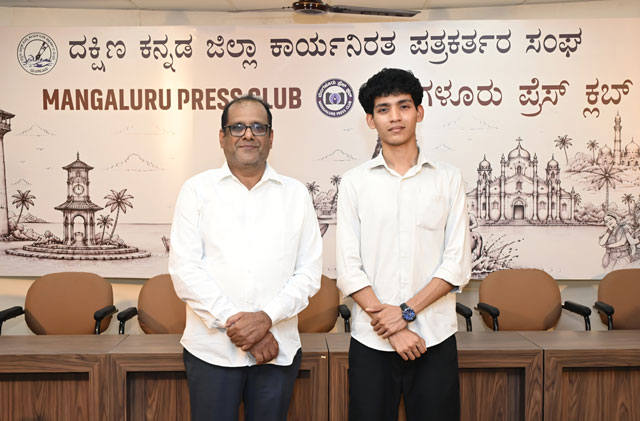
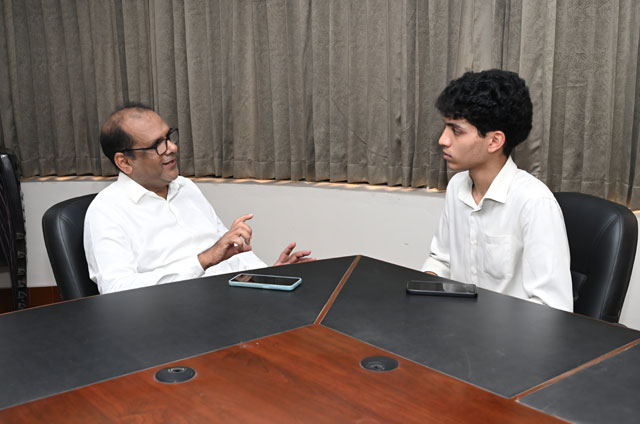
The political landscape of Coastal Karnataka moves fast, carrying deep ideological currents and sudden shifts. At the center of this beat for over three decades is veteran political journalist and acclaimed author P.B Harish Rai. Having tracked regional elections, documented political history in his books, and broken major investigative stories, Mr. Harish shares his journey from a quiet rural childhood to becoming one of the coast’s most respected media figures.
Rural Roots and Early Ambitions
Mr. Harish hails from Markanja, a remote village in Sullia Taluk that lacked basic bus facilities and paved roads during his childhood. He completed his primary schooling up to the seventh standard in the local Kannada medium school. For high school, he moved to St. Philomena High School in Puttur, studying in English medium. He later moved to Mangaluru for his Pre-University education at Government College, Hampankatta, before earning a Diploma in Electrical Engineering at Kukke Subramanya.
Student Leadership, Business, and Media Entry
His entry into public life began during his student days in Mangaluru, where he was elected as the founding President of the Dakshina Kannada District All Junior College Students Association. After completing his education, he spent two years working in Mumbai’s hospitality sector. Returning to the coast, Mr. Harish managed diverse commercial ventures, running a hotel in Gundya, operating finance firms in Subramanya and Kadaba, and holding regional distributorships for major consumer brands. He was also active in local politics and served two terms as a Director of a Cooperative Society.
Yet, a persistent passion for writing drew him toward journalism. He began by writing opinion columns and press releases for local dailies. This drive led him to join Hosa Digantha as a Sub-Editor overseeing sports reporting. At Usha Kirana, he authored a popular feature series titled Maji Shasakara Bhavanadinda, profiling the lives of former MLAs. Over the years, he worked across major dailies including Udayavani and Vijaya Karnataka—where his Meenu Market column gained wide readership—eventually taking charge as Chief Reporter at Vijayavani. Along the way, he also led the Mangaluru Press Club and the District Working Journalists Union.
Breaking Big Stories: The Parliamentary Scoop
Political reporting, as Mr. Harish explains, relies entirely on trusted networks across party offices and administrative corridors.
?He recalls one memorable scoop involving the parliamentary candidate selection of Nalin Kumar Kateel—a candidate whose nomination was completely unthinkable at the time. Kateel was just an ordinary party worker and General Secretary; media speculation was focused entirely on high-profile political heavyweights. Late one evening, a party office worker casually tipped off Mr. Harish that discussions were actually leaning toward Kateel.
?The news was so unbelievable that Mr. Harish couldn’t believe it himself at first. He immediately went to discuss and cross-check the lead with a senior colleague. Convinced of its accuracy, they prepared an exclusive story that very night.
?However, when the piece reached the news desk, the editors refused to publish it. Because Mr. Harish and Kateel shared the same community background, the desk assumed the story was merely a speculative attempt at caste-based favoritism—reasoning that such an outcome was too absurd to be true. Yet, the very next day, the party officially announced Nalin Kumar Kateel as the candidate, proving Mr. Harish’s scoop right all along.
Exposing the Watchdogs: The Election Observer Scandal
Investigative journalism plays a crucial role in pulling back the curtain on administrative hypocrisy. During election season, official Election Observers are deployed across constituencies with a single, high-minded mandate: strictly monitor candidate campaign budgets and clamp down on illegal financial excess.
Yet, as Mr. Harish began digging into ground-level operations, a startling contradiction came to light. The very officials assigned to police political spending were themselves indulging in lavish, unchecked extravagance. Rather than keeping a tight leash on public funds, certain observers were indulging in high-end living—feasting on expensive Anjal fish and prawns, buying new footwear, clothes, digital tablets, and mineral water.
When the stay was over, these exorbitant bills were quietly submitted directly to the District Administration for payment. The irony was glaring: the observers tasked with curbing election greed were billing their own luxury lifestyle to the public treasury. Recognizing the massive story at hand, Mr. Harish broke the exposé. The breaking report sent immediate shockwaves through administrative corridors, sparking widespread public outrage and forcing a fierce debate on official oversight.
High-Profile Encounters and Late-Night Assignments
Beyond routine reporting, journalism grants rare access to national figures—and sometimes requires sheer grit to bypass seemingly impossible obstacles. Mr. Harish has interviewed top leaders across the country, including an extended two-hour sit-down with Himanta Biswa Sarma, as well as private meetings with Union Minister Rajnath Singh and Maharashtra Deputy CM Eknath Shinde.
However, his most dramatic late-night assignment unfolded at one midnight at Kadri Jogi Matha during a visit by Uttar Pradesh CM Yogi Adityanath. Due to extreme security protocols, the guards had laid down an unyielding rule: only two people were permitted to step inside the private quarters upstairs—a senior political leader and one photographer.
Determined to secure an interview at all costs, Mr. Harish refused to walk away empty-handed. Coordinating on the spot with a key leader, Mr. Harish managed to slip past the heavy security cordon by filling the slot designated for the photographer. Under tight security eyes, he made his way upstairs and successfully pulled off an exclusive, late-night interview.
Decoding Coastal Karnataka’s Electoral Dynamics
Having documented political statistics in his published books, Mr. Harish frequently consults with national polling agencies like C-Voter to analyze ground trends.
He notes that voters in Dakshina Kannada and Udupi vote primarily on political party lines rather than individual candidate profiles or local development work. While exceptional leaders like Vasanth Bangera broke traditional barriers by winning assembly seats across three different party banners—BJP, JD(S), and Congress—party loyalty remains the primary driver of outcomes. Daily political debates fade quickly from public memory, and when election day arrives, the final result reflects the prevailing political wave of that exact moment.
A Legacy Beyond Headlines
Ultimately, what sets Mr. Harish apart is not just his long list of exclusives or high-profile interviews, but his unwavering dedication to truth, public interest, and ethical journalism. Across decades of rapid political change, he has remained a grounded, highly respected figure whose sharp instincts and deep integrity continue to inspire the next generation of reporters along the coast.