Daijiworld Media Network - Jerusalem
Jerusalem, Jan 9: A sharp surge in crime and gun violence across Arab towns and cities in Israel has pushed residents into a state of constant fear, with armed criminal gangs increasingly dominating public spaces and daily life.
Once vibrant neighbourhoods filled with children playing and shops staying open late have now turned unsafe, as illegal weapons and organised crime take hold. Killings, shootings and attempted attacks are being reported almost daily, driven largely by gang rivalries and clan disputes.
The opening week of the new year alone saw at least 11 Arab residents killed in separate incidents. In the northern town of Shfaram, three men were shot dead at a construction site, while a 20-year-old medical student was killed in the Bedouin town of Arara in the Negev. In another incident, a father and his teenage son from Turan were killed in Nazareth after being caught in crossfire while on a work visit. Hours later, a 30-year-old barber was shot dead inside his salon in Kafr Kara.
Social activist and lawyer Rawyah Handaqlu said residents now live under constant anxiety. “When you get an early morning phone call, you immediately fear it might be news of another shooting — a neighbour, a friend, or a relative,” she said. Handaqlu heads Eilaf, a centre working on security issues in Arab society.
According to activists, organised crime has reached a stage where armed gangs act as de facto rulers. “They control the public sphere without fear of accountability. They intimidate, attack and operate openly because they believe no one will stop them,” Handaqlu said.
Data from Eilaf indicates that nearly 77 per cent of murders take place in streets and public spaces. Figures from Abraham Initiatives, which tracks violence in Arab society, show that 252 Arab citizens were killed in 2025, compared to 116 in 2022. Nearly 90 per cent of the victims were shot dead, highlighting the widespread availability of firearms.
Kamel Rayan, founder of the Aman Centre for Combating Violence in Arab Society, described the situation as an “arms race” fuelled by easy access to weapons. “Arab society has been hijacked by criminal gangs. Ordinary citizens are being held hostage by armed men with no moral boundaries,” he said.
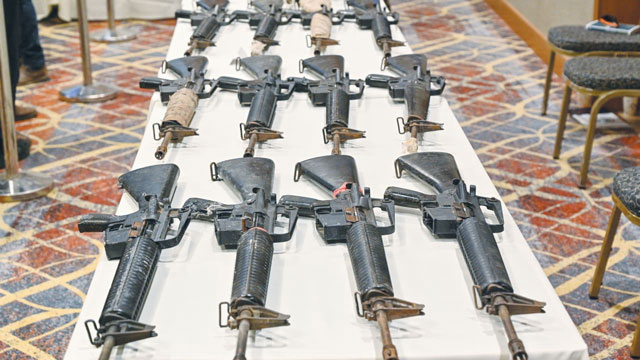
Illegal weapons are reportedly stolen from army bases, smuggled through borders with Jordan and Egypt, or manufactured in small workshops, including in the West Bank. Estimates suggest hundreds of thousands of illegal firearms may be circulating, though exact figures remain unclear.
Rayan, whose own son was killed by gun violence 16 years ago, warned that the absence of law enforcement and deterrence has normalised killings. He added that criminals are now interfering in local governance, intimidating municipal officials and even setting up their own informal “courts” to resolve disputes.
The situation has also raised alarm about its impact on youth, as criminals increasingly film violent acts and circulate the footage on social media. “Teenagers are being exposed to these videos and may begin to see criminals as role models,” Handaqlu warned.
With only around 15 per cent of murder cases reportedly solved, residents fear the violence will continue unchecked. Activists have called for decisive political action, stronger policing, and systemic reforms, warning that if left unaddressed, the violence could eventually spill over into non-Arab cities as well.