Daijiworld Media Network – New Delhi
New Delhi, Jan 27: After years of on-and-off negotiations, India and the European Union have finally concluded talks on a long-pending Free Trade Agreement (FTA), with formal implementation likely next year, Commerce Secretary Rajesh Agrawal said on Monday.
“Negotiations have been successfully concluded. The deal has been finalised,” Agrawal said, adding that while the agreement will be announced on Tuesday, processes such as legal scrubbing, signing and ratification by EU member states could take about a year.
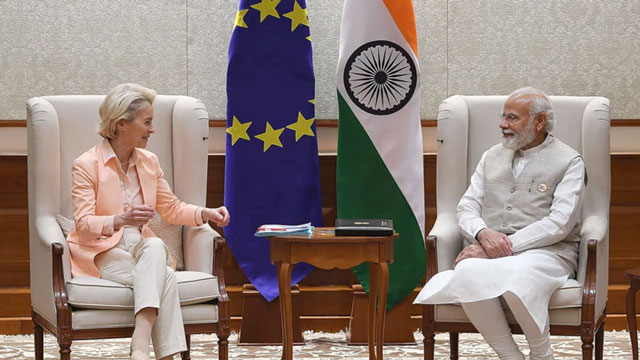
Commerce ministry sources said this marks the fourth FTA signed by India since 2025, following agreements with the UK, New Zealand and Oman last year. The deal was finalised in the presence of European Council President António Costa and European Commission President Ursula von der Leyen, who are visiting India as special guests for the Republic Day celebrations.
Prime Minister Narendra Modi said their presence reflected the growing strength of the India-EU partnership and would add momentum to cooperation across sectors. Commerce Minister Piyush Goyal described the pact as the “mother of all deals”, noting that it comes after nearly two decades of negotiations that began in 2007, were suspended in 2013 and relaunched in June 2022.
As per the Ministry of Commerce, both sides agreed to keep certain sensitive sectors outside the agreement, with India maintaining a protectionist stance on dairy and agriculture. Von der Leyen said a successful India would contribute to global stability and prosperity, adding that India-EU engagement would also culminate in the signing of a Security and Defence Partnership.
India currently enjoys a trade surplus of nearly $15 billion with the EU, exporting goods worth $75.9 billion and importing $60.7 billion in FY2025. The EU accounts for about 17 per cent of India’s goods exports and nearly one-third of its IT services exports. Analysts estimate the FTA could boost India’s exports to the EU by over 50 per cent in the next five years.
The Global Trade Research Initiative noted that India and the EU are complementary partners rather than rivals, with India exporting labour-intensive goods and the EU supplying capital goods, advanced technology and industrial inputs, making the agreement beneficial for both sides.