Daijiworld Media Network - Chandigarh
Chandigarh, Apr 28: In a swift operation following a blast attempt near a railway track, the Punjab Police has dismantled a suspected terror module allegedly backed by Pakistan’s ISI, arresting four individuals within 24 hours of the incident.
The operation was launched after an attempted detonation on the railway track near Shambhu late Monday night. Officials said the arrested individuals are highly radicalised and have a history of criminal activity.
The accused have been identified as Pardeep Singh Khalsa of Mansa, Kulwinder Singh Bagga from Bappiana village in Mansa, Satnam Singh Satta from Tarn Taran, and Gurpreet Singh Gopi from Goindwal Bypass in Tarn Taran.
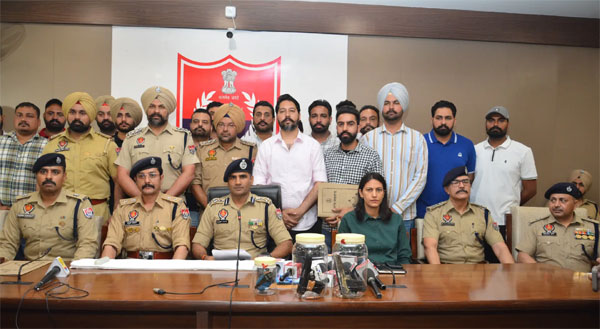
According to police officials, the recovered material includes a hand grenade, two .30 bore pistols with ammunition, advanced communication devices, and laptops allegedly used to coordinate with handlers. Investigators believe the group was in contact with foreign-based operatives and arms suppliers.
Senior officials including Kuldeep Chahal and Varun Sharma stated that the module was uncovered within 12 hours of the attempted attack, calling it a significant breakthrough.
Police identified Khalsa as the alleged mastermind, claiming he maintained links with overseas radical networks and had connections with handlers based in Pakistan and Malaysia. He is also accused of sending radicalised individuals abroad for training and forming a group named “Chalda Vaheer Chakarwarti, Attariye.”
Preliminary investigation suggests the group had earlier carried out a low-intensity IED blast at the Shambhu railway station main line. Authorities further stated that the module was planning additional attacks targeting public infrastructure.
An FIR has been registered in Patiala under multiple provisions of the Bharatiya Nyaya Sanhita, the Explosives Act, the Arms Act, and the Unlawful Activities (Prevention) Act (UAPA).
Police said further investigation is underway to trace wider networks and prevent any future attempts at similar attacks.