Daijiworld Media Network – Bengaluru
Bengaluru, May 1: A staggering employability crisis has come to light in Karnataka, with a high-level committee revealing that only 17% of engineering graduates in the state are currently fit for employment.
The Committee for Transformation of Engineering Education in Karnataka, led by Professor Sadagopan along with prominent professors from IIIT and IISc, submitted these findings in a detailed study recently presented to the department of higher education.
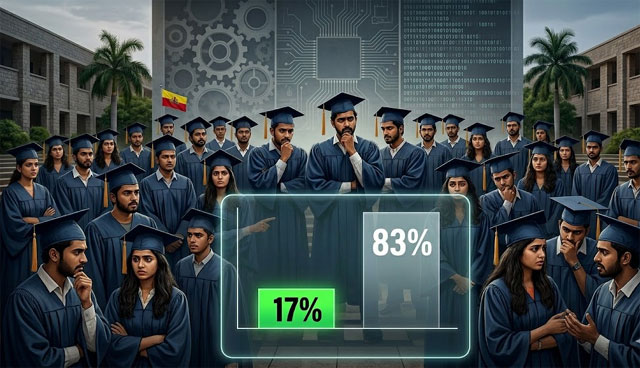
Representational image
The report identifies several critical factors contributing to this crisis, including mass unemployment among computer science graduates and a sharp decline in enrollments for core engineering branches such as mechanical, civil, and electrical engineering. It further notes a decline in the quality of state engineering colleges at both national and international levels, a failure to adapt core branches to cross-domain realities, and an overall lack of competency among students.
Shortage of professionals in aerospace and defense
The committee warned that India's semiconductor sector will face a talent gap of 2.5 to 3 lac professionals by 2027, with Karnataka’s specific shortage estimated at 10,000 to 15,000 professionals.
Similarly, there is a significant dearth of experts in the aerospace and defense sectors—a gap that computer science or IT graduates cannot fill. To address these issues, the committee has recommended the establishment of the Karnataka Engineering Education Reform Authority (KEERA), which will manage essential engineering data to support the sector.
Higher education minister Dr M C Sudhakar stated, "A separate act must be passed to establish this authority, and we will begin preparations soon. Through this authority, various curriculum changes across engineering streams will be implemented in phases".
New regulations for seat intake and accreditation
To improve quality, the committee has recommended strict limits on student intake. New private universities or colleges should initially be limited to 60 admissions per course. This may be increased by 60 seats annually, up to a maximum of 180 during the first four years.
Further increases in intake are contingent upon accreditation from the National Board of Accreditation (NBA). Private universities must also secure NAAC accreditation. The report stresses that the total student strength for any single course should not exceed 300.
Additionally, private institutions will be prohibited from starting more than five computer-related courses at any time, with the total student strength across all computer disciplines capped at 900.
Existing private and deemed universities that currently exceed 300 admissions in a specific course must obtain NBA accreditation within two years of these rules being notified. Failure to comply will result in a mandatory reduction of seats as per the department of higher education regulations.