Daijiworld Media Network – Haryana
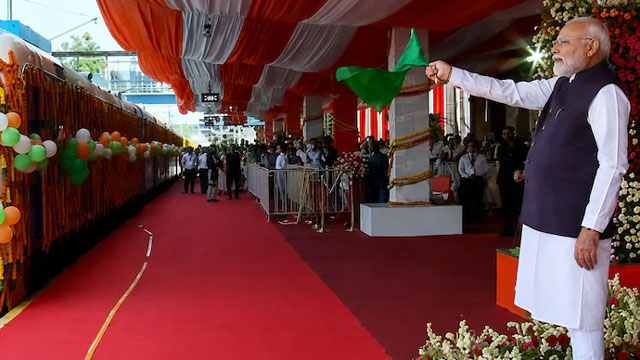
Haryana, Jul 17: Prime Minister Narendra Modi on Friday launched India’s first hydrogen-powered train from Jind railway station in Haryana, marking a significant milestone in the country’s efforts towards cleaner and more sustainable rail transportation.
The hydrogen fuel cell-powered train will initially operate on the 89-km Jind-Sonipat route under Northern Railway. The service will connect Jind Junction, Gohana Junction and Sonipat, covering several stations and halts along the route.
Unlike conventional electric trains that rely on overhead power supply, the new train generates electricity onboard through hydrogen fuel cell technology. The system combines hydrogen with oxygen from the atmosphere to produce electricity, with water vapour and heat being the only by-products.
Railway officials said the technology brings back the concept of self-powered trains while replacing traditional fossil fuels such as coal and diesel with cleaner hydrogen energy. The technology eliminates the need for combustion and reduces dependence on external electricity sources.
The train has been equipped with advanced safety features, including systems to detect hydrogen leaks, excessive heat, flames and smoke. An integrated monitoring mechanism continuously tracks onboard conditions and enables quick response in case of any emergency.
The hydrogen train has a maximum operational speed of 75 kmph and a design speed of 110 kmph, which is expected to improve connectivity and efficiency on the Jind-Sonipat corridor.
Hydrogen-powered passenger trains are still in the early stages of adoption globally. Germany became the first country to introduce hydrogen trains for commercial operations, while countries including France, Italy, Japan and China are currently testing or operating the technology on limited routes.
Most hydrogen trains currently running worldwide are designed for regional services and generally consist of two to four coaches.
The launch is seen as a major step towards Indian Railways’ goal of reducing carbon emissions and adopting environmentally friendly technologies for future transportation.