Daijiworld Media Network - New Delhi
New Delhi, Aug 7: The Lok Sabha on Friday passed a Bill seeking amendments to the Payment and Settlement Systems Act, 2007, paving the way for the government to allow banks and payment service providers to levy charges on Unified Payments Interface (UPI) and other notified electronic payment modes.
The Taxation and Other Laws (Amendment) Bill, 2026, which was passed by voice vote amid opposition uproar without a detailed discussion, seeks to remove the existing legal restriction that prevents banks and payment service providers from imposing Merchant Discount Rate (MDR) on notified electronic payment transactions.
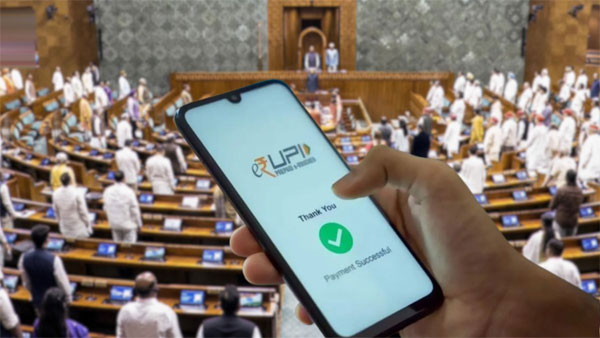
At present, real-time payment systems such as RTGS and NEFT involve service charges, while UPI transactions have remained free of such fees since their introduction.
The amendment is part of a wider legislative package involving changes to taxation laws. Finance Minister Nirmala Sitharaman moved the Bill for consideration after the House resumed proceedings at 2 pm following an earlier adjournment.
The amendment proposes replacing the reference to electronic payment modes prescribed under Section 269SU of the Income Tax Act, 1961, with a provision allowing the Centre to notify one or more electronic modes of payment that may be brought under the charging framework.
Section 10A of the Payment and Settlement Systems Act, 2007, currently prohibits banks and payment system operators from imposing any direct or indirect charges on electronic payment modes specified under Section 269SU of the Income Tax Act.
Under Section 269SU, businesses with annual turnover exceeding Rs 50 crore are required to provide certain digital payment options, including RuPay debit cards and BHIM-UPI QR codes.
The proposed change could create a framework for introducing MDR on UPI transactions, though the government is yet to announce any specific charge structure.
Reserve Bank of India Governor Sanjay Malhotra had on Wednesday said that discussions on introducing MDR for digital payments were still premature. He said investment in payment infrastructure needs to be funded either through taxation or through a user-pay model such as MDR.
"The choices before us are simple: either the general public has to pay for it through taxes, or we have to levy the merchant discount rate (MDR), following the 'user pays' model," Malhotra said.
He added that the focus remains on strengthening digital payment infrastructure and ensuring its sustainability.
The issue of MDR on UPI transactions has remained debated, with banks and payment industry stakeholders seeking a mechanism to recover costs involved in maintaining payment networks. However, the government had so far refrained from imposing charges as UPI adoption continued to expand rapidly.
Industry observers have suggested that any future MDR framework could potentially apply only to higher-value merchant transactions and may not cover person-to-person payments.
The RBI Governor also highlighted that under the user-pay principle, the cost is borne by the individual or merchant conducting the transaction. In the absence of MDR, he said, the wider public effectively bears the cost through government spending and taxation.
The amendment now provides the legal basis for the government to notify electronic payment modes that may be subject to charges in the future.