Daijiworld Media Network - Kathmandu
Kathmandu, Aug 31: Rescue operations have intensified across Nepal after a devastating flash flood swept through the Bhotekoshi-Trishuli river corridor on August 26, leaving hundreds of hydropower workers trapped or unaccounted for inside tunnels at multiple power projects.
According to data from Nepal’s Independent Power Producers’ Association (IPPAN), 933 workers at 13 hydropower projects were initially reported out of contact following the disaster. Of these, 254 had been rescued by August 28, while others subsequently established contact, leaving hundreds still unaccounted for.
More recent reports indicate that the number of workers still trapped or missing has fallen as rescue teams have reached some sites. Hindustan Times, citing Nepal government data, reported that 573 workers remained trapped or out of contact at 11 hydropower sites, after 361 workers had either been rescued or managed to escape on their own.
The worst-affected projects are located in Rasuwa and Nuwakot districts, along the Bhotekoshi-Trishuli river system near the Nepal-China border. The catastrophic flooding sent enormous quantities of water, mud, rocks and debris through the valleys, damaging hydropower facilities and blocking access roads and tunnels.
The 216-MW Upper Trishuli-1 hydropower project in Rasuwa is among the hardest-hit facilities. According to data reported by Nepali media, 576 workers at the project were initially unaccounted for. Rescue teams have since managed to bring some workers out, but a large number remain missing.
The situation is also critical at other projects. At the 111-MW Rasuwagadhi Hydropower Project, 93 people were initially reported missing, while 42 were unaccounted for from the 20-MW Langtang Khola project. Eight workers from the 22-MW Chilime project and seven from the 5-MW Mailung Khola project were also reported missing, according to data released by Ratopati.
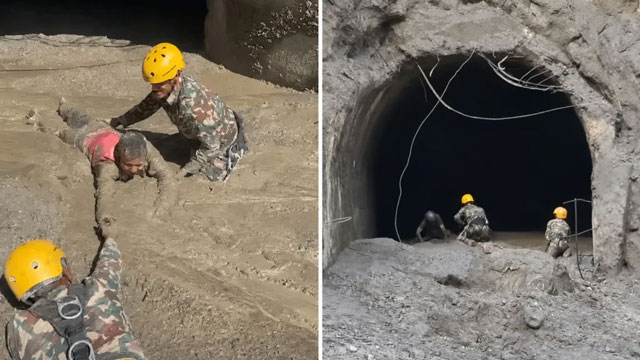
Rescuers are particularly concerned about workers who may have been buried behind huge quantities of silt and debris inside underground tunnels. In some locations, teams have been trying to clear blocked passages while simultaneously attempting to determine whether people remain alive inside.
At the Trishuli 3A project, rescue teams have been working to reach workers believed to be trapped underground. In some tunnel operations, rescuers have used pipes to supply air to areas where people may still be alive beneath the debris.
A dramatic rescue was also reported from the Upper Trishuli-1 project, where workers were pulled from a mud-filled tunnel. Footage released from the operation showed survivors emerging through thick mud as rescue personnel worked to evacuate them.
The disaster has created extremely difficult conditions for rescuers. Heavy mud, damaged roads, unstable terrain, continuing rainfall and the risk of further flooding have slowed operations. Nepal has deployed thousands of soldiers and police personnel for search and rescue operations, while teams from India and China have also been assisting with the emergency response.
The flash flood itself was linked to a glacial collapse and avalanche on the Tibetan side of the border, which sent a huge volume of water, ice, rock and mud into the Lhende Khola and subsequently into the Bhotekoshi and Trishuli river systems. The resulting torrent devastated settlements and infrastructure across the region.
The broader disaster has resulted in a rapidly rising death toll and thousands of people being reported missing across Nepal and Tibet. As of Monday, Nepal had reported 903 deaths and more than 4,200 missing, while China had reported 16 deaths and 546 missing in Tibet, according to the Associated Press.
Hydropower workers are a particularly significant group among those missing because many of the affected projects are located deep inside narrow Himalayan valleys, where workers were underground when the flood struck. The sudden arrival of the floodwaters gave people little time to escape.
The crisis has also raised concerns over Nepal's dependence on hydropower infrastructure located in vulnerable mountain valleys. The country's hydropower sector is crucial to its electricity supply and economy, but many facilities are situated downstream from areas exposed to landslides, glacial activity and sudden floods.
Rescue teams are continuing to search the affected tunnels and project sites, with authorities racing against time to locate workers who may still be alive beneath the mud and debris.