Daijiworld Media Network - New Delhi
New Delhi, Aug 31: A 25-year-old dispute between Bihar and Jharkhand over sharing the waters of the Son River was resolved on Monday with the two states signing a Memorandum of Understanding (MoU) in the national capital.
Under the agreement, Bihar will receive 5.75 million acre-feet (MAF) of water from the river, while Jharkhand has been allocated 2.00 MAF.
The MoU was signed in the presence of Union Home Minister Amit Shah, Union Jal Shakti Minister C R Patil, Bihar Chief Minister Samrat Choudhary, Jharkhand Chief Minister Hemant Soren, Bihar Deputy Chief Minister and Water Resources Minister Vijay Kumar Choudhary, besides senior officials from the Centre and both state governments.
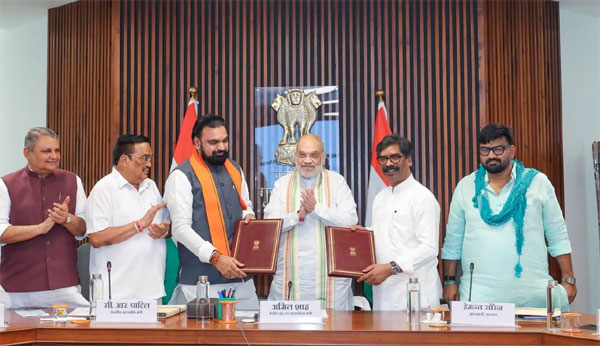
Describing the agreement as historic, Bihar Chief Minister Choudhary expressed gratitude to Prime Minister Narendra Modi and Home Minister Amit Shah. He said the long-pending and complex dispute was resolved through the Centre’s initiative, continuous dialogue and effective mediation.
According to Choudhary, the agreement is not merely a water-sharing arrangement but marks a new chapter of cooperation, trust and shared development between Bihar and Jharkhand.
The Chief Minister recalled that under the 1973 Bansagar Agreement, of the total 14.25 MAF water available in the Son River, Madhya Pradesh was allocated 5.25 MAF, Uttar Pradesh 1.25 MAF and the then undivided Bihar 7.75 MAF.
Following the creation of Jharkhand in 2000, a dispute arose over the division of Bihar’s 7.75 MAF share between the two states.
Choudhary said significant progress was made during the 27th meeting of the Eastern Zonal Council, chaired by Home Minister Amit Shah in Ranchi on July 10, 2025. Subsequent rounds of technical and administrative discussions eventually resulted in a final consensus between the two states.
The agreement is expected to give a major boost to irrigation, drinking water supply and industrial development in the plateau and drought-prone regions of southern Bihar and Jharkhand.
Improved water availability is likely to expand irrigation coverage, ease drinking water shortages and strengthen long-term water security in both states.
According to Choudhary, the settlement will also accelerate plans for reservoir construction and the proposed Son-Falgu river-linking project aimed at improving water utilisation.
The initiative is expected to enhance water availability in several parts of south Bihar, including Gaya. Adequate flow in the Falgu River would also benefit pilgrims visiting Gaya during the annual Pitrapaksha Mela by facilitating rituals such as tarpan and pind daan.
Highlighting the wider significance of the agreement, Choudhary said the Son River is one of the major southern tributaries of the Ganga and its catchment area plays a crucial role in the agricultural and economic activities of eastern India.
He said the agreement therefore carries long-term importance not only for Bihar and Jharkhand but also for water management and regional development across eastern India.
Choudhary also thanked the Union Jal Shakti Ministry, the Jharkhand government and officials and experts involved in the negotiations.
He said the successful resolution of such a complex inter-state issue demonstrated the strength of cooperative federalism and would benefit farmers, local communities and future generations.