Daijiworld Media Network – Mumbai
Mumbai, Sep 1: Adani Group chairman Gautam Adani on Monday called for a broader approach to evaluating India’s infrastructure projects, saying conventional credit-rating models may fail to capture the wider economic and strategic value created by large infrastructure platforms.
Speaking as the chief guest at the CareEdge Group Annual Summit in Mumbai, Adani said India’s rapidly expanding roads, ports, airports, renewable energy and digital infrastructure required more sophisticated frameworks to assess their risks and potential.
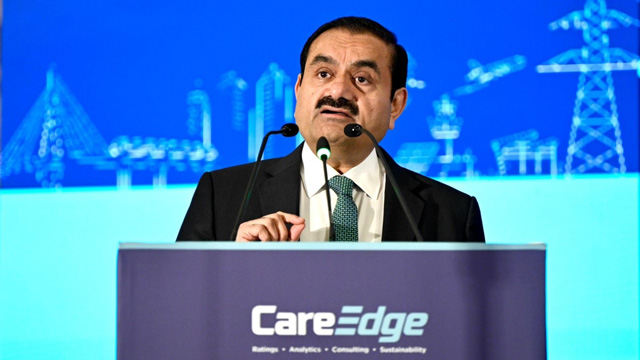
“Our roads are expanding at unprecedented speed. Our ports are transforming. Our airports are connecting more nations than ever before. Our renewable energy capacity is growing faster than any other nation on earth. Our digital infrastructure is reaching hundreds of millions,” he said.
Adani stressed that his proposal was not aimed at lowering credit standards or weakening scrutiny. Instead, he urged rating agencies to adopt what he called “wider lenses” to assess infrastructure whose value extends beyond the cash flows of an individual asset.
“India does not need lower standards. India needs wider lenses,” he said, calling on CareEdge to develop a comprehensive credit framework for what he described as “integrated platform infrastructure”.
According to Adani, traditional credit models were largely designed around individual assets and projected cash flows. However, modern infrastructure projects can create wider ecosystems, generate new demand and support the development of new industries.
He divided infrastructure into three categories — replacement infrastructure, growth infrastructure and platform infrastructure. While conventional rating models may be adequate for replacement projects, he said growth and platform infrastructure require assessments that consider ecosystem effects and long-term strategic value.
Citing the Mundra port in Gujarat, Adani said the project had evolved from a port on a relatively undeveloped coastline into a wider logistics and industrial ecosystem connected to railways, logistics centres, power generation and manufacturing.
He also highlighted the Vizhinjam International Seaport in Kerala, saying its strategic location near major international shipping routes could help India reduce its dependence on overseas transshipment hubs.
Adani said projects such as Mundra and Vizhinjam should not be assessed only on their standalone financial returns, as their wider economic impact could be much greater.
“The greatest risk was never in building Vizhinjam. The greatest risk was India continuing to believe that it could not,” he said.
Adani also cited the Adani Green Energy project at Khavda in Gujarat’s Kutch region, where the company is developing 30 GW of renewable energy capacity. He said such large-scale clean energy infrastructure could provide the foundation for data centres, artificial intelligence, advanced manufacturing and other energy-intensive industries.
“AI may look like software. But ultimately, AI runs on infrastructure,” Adani said, highlighting the importance of electricity, data centres, cooling systems, transmission networks and land for the expansion of artificial intelligence.
He said India’s future competitiveness in AI and other emerging sectors would depend not only on software and algorithms but also on its ability to develop infrastructure capable of supporting computing and industrial activity on a massive scale.
Adani reiterated that his call was not for easier ratings or reduced scrutiny, but for dynamic assessment models that recognise the broader economic impact and long-term potential of national infrastructure platforms.