Daijiworld Media Network – Bengaluru
Bengaluru, Oct 13: In a setback to the Karnataka government, the High Court of Karnataka has struck down provisions of the 2022 law that increased reservations for Scheduled Castes (SCs) from 15% to 17% and for Scheduled Tribes (STs) from 3% to 7%, declaring Sections 3 and 4 unconstitutional.
The court held that the provisions allowing the overall reservation quota to exceed the 50% ceiling violated constitutional guarantees of equality and equal opportunity. The reservation for Other Backward Classes (OBCs) had remained unchanged at 32%, taking the total quota beyond the prescribed limit.
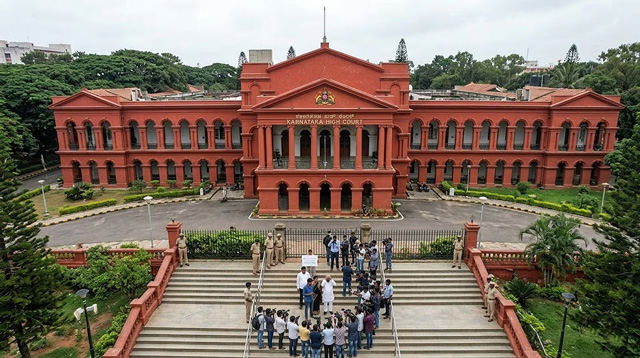
A division bench comprising chief justice Vibhu Bakhru and justice K S Hema Lekha ruled that the relevant portion of Section 3 violated Articles 14 and 15 of the Constitution, while Section 4 violated Articles 14 and 16. Both provisions were consequently struck down.
The verdict came while the bench was hearing several petitions, including a public interest litigation filed by Mahendra Kumar Mitra and others, challenging the state's authority to increase reservations without complying with constitutional requirements relating to equality, equal protection and equal opportunity.
The Karnataka Scheduled Castes and Scheduled Tribes (reservation of seats in educational institutions and of appointments or posts in the services under the state) Act, 2022, came into effect on January 12, 2023.
National Commissions must be consulted before major policy decisions
In its ruling, the High Court referred to several Supreme Court judgments, including the landmark Indra Sawhney case, and stressed that the state's legislative power was subject to constitutional requirements.
The bench held that consultation with the National Commission for Scheduled Castes and the National Commission for Scheduled Tribes was mandatory before taking major policy decisions affecting the two communities, as stipulated under Articles 338(9) and 338A(9) of the Constitution.
The court made it clear that merely writing to the commissions after enacting the law could not be treated as meaningful consultation.
The state government had written to the two commissions on December 10, 2025, and January 20, 2026. However, these communications were sent nearly three years after the legislation came into force and after its constitutional validity had been challenged in court.
The bench observed that consultation must be meaningful and effective, and must take place before a decision is made. Post-facto correspondence, it said, could not satisfy this constitutional requirement.
State's defence of Legislative powers rejected
During the hearing, the state government argued that the 50 per cent reservation ceiling was no longer applicable. It maintained that Articles 245 and 246 of the Constitution empowered the state legislature to enact laws and that this authority was not restricted by Articles 338(9) and 338A(9).
The High Court rejected this interpretation, observing that while the state's legislative competence was not in dispute, it could not claim exemption from restrictions imposed by other constitutional provisions.
The bench emphasised that the requirement to consult the relevant national commissions could not be bypassed when taking major policy decisions affecting SCs and STs.
Population share cannot alone justify exceeding 50% cap
The government had also argued that more than 90% of Karnataka's population belonged to SC, ST and OBC communities, and that reservation levels should reflect their share of the population.
The court declined to accept this reasoning, observing that such an approach would undermine the constitutional principle of equality.
It clarified that the 50% reservation ceiling applied not only to Article 16(4), which concerns reservations in public employment, but also to Article 15(4), which provides for special provisions for socially and educationally backward classes and SCs and STs. Any exception to the ceiling, it said, required compelling justification based on exceptional circumstances.
The bench also examined arguments concerning the Ratna Prabha Committee report, on which the state had relied while framing its reservation policy. It noted that the principal question before it was not whether the state legislature had the authority to enact reservation legislation, but whether the overall quota could exceed the 50% ceiling.
Nagamohan Das report cannot justify breach of ceiling
The High Court observed that findings in the Nagamohan Das Commission report indicating that certain communities remained socially marginalised and had not adequately benefited from reservation could support the introduction of internal reservations. However, such findings could not, by themselves, justify exceeding the overall 50% ceiling.
The bench further held that the fact that certain communities had lower representation in state government services than their proportion of the population did not automatically constitute an exceptional circumstance warranting a breach of the ceiling.
“Even if the reservation quota is 18% and the share of the relevant communities in the population is 24.10%, this does not establish the necessity of exceeding the 50% ceiling,” the court observed in its order.
It added that increasing reservations would correspondingly reduce the number of posts available to candidates competing under the general category.
Bommai urges government to move Supreme Court
Reacting to the verdict, former chief minister and BJP MP representing Haveri, Basavaraj Bommai urged the state government to challenge the High Court's decision in the Supreme Court. He warned that he would approach the apex court himself if the government failed to do so.
Bommai said the increase in SC/ST reservations had been introduced during his tenure as chief minister on the basis of the Justice Nagamohan Das Committee report. The relevant bill had also been passed by both Houses of the state legislature, he noted.
Alleging that some people had filed public interest litigation to oppose the development of SC and ST communities, Bommai insisted that the state government must take the matter to the Supreme Court.
The High Court's ruling has placed the legal validity of Karnataka's enhanced SC/ST reservation quotas at the centre of a fresh debate, with the government's next move likely to determine the course of further legal proceedings.