Quick Summary
- Your gold loan amount depends on the jewellery's purity, net gold weight and the lender's valuation.
- The current gold price affects the value assigned to your pledged jewellery.
- The gold loan LTV ratio determines the maximum eligible loan amount against the assessed gold value, subject to applicable RBI regulations.
- A gold loan per gram estimate can help you understand your borrowing potential, but the final amount depends on the lender's assessment.
- A gold loan eligibility calculator can help you estimate the amount you may be eligible to borrow.
- Before applying, compare the gold loan interest rate, repayment terms, applicable charges and other conditions.
How Is the Gold Loan Amount Determined?
The amount you can borrow against your jewellery is based on the value of the eligible gold you pledge. Lenders assess the jewellery and apply the applicable LTV limit to determine the maximum eligible loan amount.
Three primary factors influence this calculation:
Gold Purity and Weight
Gold purity indicates the proportion of gold in a piece of jewellery. It is commonly expressed in karats, with 24-karat gold representing nearly pure gold and 22-karat gold containing a lower proportion of gold by weight.
Lenders assess the purity and net weight of eligible gold to determine its value. The weight of stones, beads, clasps made from other materials and other non-gold components is excluded from the gold valuation.
For example, two jewellery pieces weighing 10 grams each may have different assessed values if their purity differs.
Current Gold Value
Gold prices change with international market movements, currency fluctuations and domestic market conditions. Lenders use the applicable valuation method and reference price to assess the gold offered as collateral.
The following factors can influence the assessed value:
- Current gold prices applicable to the relevant purity.
- Net weight of the eligible gold, excluding non-gold components.
- Purity established during the lender's assessment.
Making charges and the sentimental or resale value of jewellery do not necessarily contribute to its gold loan valuation.
Loan-to-Value (LTV) Ratio
The loan-to-value ratio represents the proportion of the assessed gold value that a lender can offer as a loan. The applicable limit depends on RBI regulations, the loan category and the relevant lender's terms.
For example, if eligible gold is valued at Rs 1,00,000 and an illustrative LTV of 75% applies, the maximum loan amount under that assumption would be Rs 75,000.
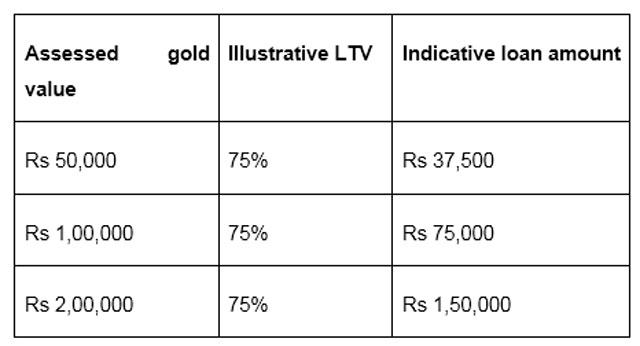
*These examples are for illustration only. The actual LTV limit and eligible amount depend on applicable regulations, loan terms and the lender's assessment.
How to Calculate Your Gold Loan Amount
You can estimate your potential gold loan amount by understanding how the value of your jewellery is assessed and how the applicable LTV ratio is applied.
Indicative formula:
Gold loan amount = Assessed value of eligible gold × Applicable LTV ratio
Gold Weight and Purity Assessment
Start by identifying the net weight and purity of the jewellery you intend to pledge. A lender will verify these details during the valuation process.
For instance, jewellery weighing 20 grams may not be valued as 20 grams of pure gold. The purity and weight of non-gold components must be considered before calculating its eligible gold value.
Understanding the Value of Pledged Gold
Once the net weight and purity are established, the lender determines the applicable value using its prescribed valuation method.
An illustrative calculation for 10 grams of eligible gold valued at Rs 10,000 per gram would be:
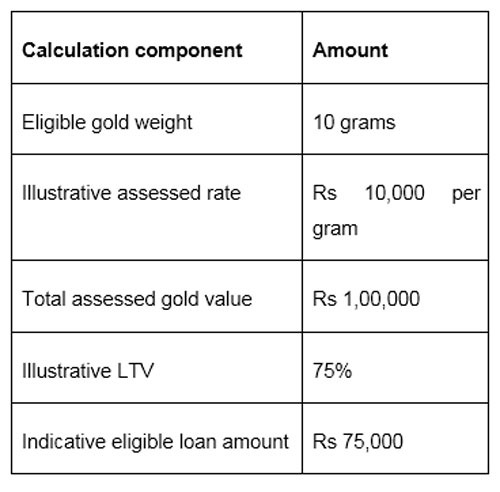
The rate used here is hypothetical, not a live gold rate or an offer from L&T Finance. Actual valuation may differ based on purity, applicable reference prices and the lender's assessment.
Applying the Applicable LTV Ratio
The LTV ratio sets the maximum proportion of the assessed gold value that can be extended as credit. It is not necessarily the amount every borrower will receive.
The applicable RBI framework may prescribe different limits for different loan categories and ticket sizes. Lenders must follow the relevant regulatory requirements and their own eligibility conditions.
Your final eligible amount may therefore be lower than an initial estimate.
Factors That Affect Your Gold Loan Eligibility
Gold Purity and Net Weight
Higher-purity eligible gold generally has a higher value per gram than lower-purity gold, assuming comparable reference prices. A greater net weight of eligible gold can also increase the assessed value.
However, jewellery containing a significant proportion of stones or non-gold materials may have a lower eligible gold weight than its total weight suggests.
Gold Prices
A higher applicable gold rate may increase the assessed value of your jewellery, while a lower rate may reduce it. Since prices fluctuate, an estimate made today may differ from the valuation carried out when you apply.
If you are checking the gold loan per gram value, use the rate relevant to your jewellery's purity and treat online estimates as indicative rather than guaranteed.
Lender Policies and Eligibility Criteria
The final loan amount also depends on the lender's assessment, eligible collateral, documentation and applicable loan conditions. Some jewellery may not qualify under a lender's product terms.
Before applying, check the accepted forms of gold, minimum documentation requirements, applicable charges and repayment conditions.
How to Get the Maximum Gold Loan Against Jewellery
The amount you can borrow is subject to the applicable LTV limit. While you cannot increase the regulatory limit, you can take practical steps to understand the value of your jewellery and make an informed borrowing decision.
Keep Jewellery in Good Condition
Store your jewellery safely and keep it accessible for assessment. The loan amount depends primarily on eligible gold content, purity and valuation rather than appearance or sentimental value.
Compare Gold Loan Terms
Do not compare lenders only by the estimated loan amount. Review the overall borrowing terms before choosing a gold loan.
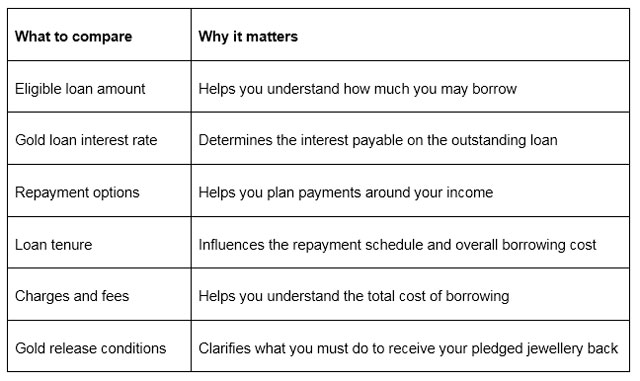
Understand Applicable Charges
Ask for details of the gold loan interest rate, processing fees and other applicable charges before accepting an offer. Also review the repayment schedule, overdue-payment terms and conditions for releasing the pledged jewellery.
Choose a loan amount that meets your requirements and is manageable within your repayment capacity rather than borrowing the maximum available amount by default.
Gold Loan Calculator: Estimate Your Eligible Loan Amount
A gold loan eligibility calculator can help you estimate how much you may be able to borrow against your jewellery. It provides an initial understanding of your borrowing potential before you approach a lender.
How a Gold Loan Calculator Works
A calculator typically uses inputs such as the weight of eligible gold, purity, applicable gold rate and LTV ratio to estimate the loan amount. Depending on the tool, you may also be able to explore interest costs or repayment estimates.
Use the estimate as a starting point. The lender's physical gold assessment and applicable loan terms determine the final eligible amount.
Benefits of Estimating the Loan Amount Before Applying
Using a gold loan calculator can help you:
- Plan your borrowing: Estimate whether the loan may cover your financial requirement.
- Compare options: Understand how differences in gold valuation and loan terms can affect the amount.
- Prepare a repayment budget: Consider the interest cost and repayment obligations before borrowing.
- Avoid over-borrowing: Choose an amount that suits your needs and repayment capacity.
Important Things to Check Before Taking a Gold Loan
Before pledging your jewellery, review the following:
- Interest rate: Check the applicable rate and how interest is calculated.
- Repayment terms: Understand the repayment schedule, tenure and payment options.
- Charges: Review processing fees and other applicable costs.
- Loan agreement: Read the terms covering overdue payments, default and release of pledged gold.
- Eligibility and documentation: Confirm the lender's requirements before applying.
- Repayment capacity: Borrow only what you can reasonably repay within the agreed terms.
A gold loan can help meet planned or unexpected expenses, but it is important to understand the financial commitment and the conditions under which your jewellery will be returned.
Conclusion
The gold loan amount you can receive against your jewellery depends on its purity, net weight, current assessed value and the applicable LTV ratio. Using a gold loan eligibility calculator can provide an initial estimate, while comparing the gold loan interest rate, charges and repayment terms helps you assess the overall cost of borrowing.
At L&T Finance, we encourage borrowers to understand their loan terms and repayment commitments before making a decision. You can also explore the L&T Finance Planet App to access available digital financial services and manage your financial needs.
FAQs
How much gold loan can I get for 10 grams of gold?
The amount depends on the purity of your gold, its assessed rate per gram and the applicable LTV ratio. For example, if 10 grams of eligible gold is valued at Rs 10,000 per gram and an illustrative LTV of 75% applies, the estimated loan amount would be Rs 75,000. Actual eligibility may differ.
How is the value of gold calculated for a gold loan?
Lenders assess the jewellery's purity and net gold weight, excluding stones and other non-gold components. They then apply the relevant gold valuation method to determine the eligible collateral value. The applicable LTV ratio is used to establish the maximum eligible loan amount.
Does gold purity affect the loan amount?
Yes. Gold purity affects the amount of actual gold contained in the jewellery and therefore its assessed value. For the same net weight, higher-purity eligible gold will generally have a higher assessed value than lower-purity gold, subject to the applicable valuation method.
What is the LTV ratio for a gold loan?
The loan-to-value (LTV) ratio is the proportion of the assessed gold value that can be offered as a loan. The applicable limit depends on RBI regulations, the loan category and ticket size, and the lender's terms. The final eligible amount is subject to the lender's assessment.
Can I get a gold loan against all types of gold jewellery?
Not necessarily. Eligibility depends on the lender's product terms and the type, purity and assessable gold content of the jewellery. Stones and other non-gold components are generally excluded from the gold valuation. Check the lender's accepted collateral and eligibility requirements before applying.