Media Release
Mangaluru, Nov 2: In a significant advancement in paediatric cancer care, Father Muller Medical College Hospital (FMMCH), Mangaluru, has successfully performed Intra-Arterial Chemotherapy (IAC) for a child diagnosed with retinoblastoma, a rare form of eye cancer affecting young children.
The surgery was conducted in the second week of October and has shown considerable improvement during their routine visit in the last week of October 2026.
This marks the first reported use of this advanced eye-preserving treatment in Mangaluru, bringing specialised cancer care closer to home for children who would otherwise have to travel to major metropolitan centres for such procedures.
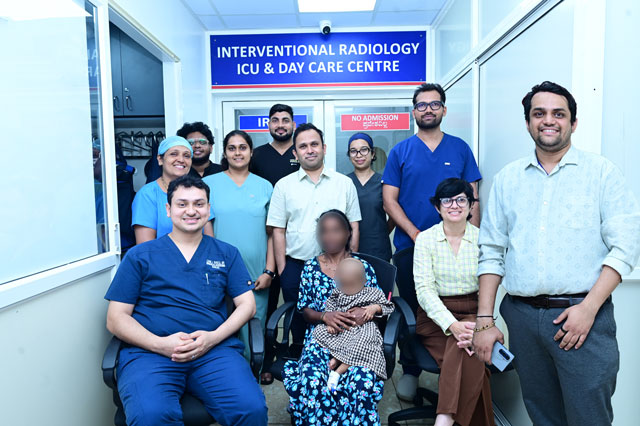
Performed by Dr Lenon D’Souza, unit chief & associate professor, Interventional Radiology and Dr Mandeep Sagar, associate professor, Interventional Radiology; along with their team from the Department of Interventional Radiology, in collaboration with Dr Sripathi Kamath, Professor, Department of Ophthalmology at FMMCH.
A minimally invasive procedure offering hope to save the eye
Retinoblastoma is a potentially life-threatening cancer that develops in the retina, the light-sensitive tissue at the back of the eye. In advanced cases, surgical removal of the affected eye may become necessary to control the disease.
Intra-Arterial Chemotherapy offers an innovative, minimally invasive alternative in selected patients, with the potential to preserve the affected eye.
During the procedure, a very thin, flexible tube is carefully guided through the blood vessels to reach the tiny blood vessel supplying the tumour in the affected eye.
Chemotherapy is then delivered directly into this blood vessel, allowing a high concentration of anticancer medication to reach the tumour while reducing exposure to the rest of the body. This targeted approach can help minimise some of the side effects commonly associated with conventional intravenous or systemic chemotherapy.
For this child, the procedure offered an important opportunity to control the tumour and potentially avoid surgical removal of the eye.
Advanced technology enabling precision treatment
A key factor contributing to the successful procedure was the availability of the state-of-the-art Philips Azurion Biplane Cath Lab at the Department of Interventional Radiology, FMMCH.
Equipped with advanced 3D angiography and 3D navigation capabilities, this sophisticated imaging system allows doctors to visualise intricate blood vessels in exceptional detail and precisely guide extremely thin tubes through the delicate blood vessels supplying the eye.
The facility, described as the first of its kind in Dakshina Kannada, has been immensely valuable in enabling the Interventional Radiology team to perform such complex, minimally invasive procedures with greater precision, safety and effectiveness.
The intervention was performed under general anaesthesia, with Dr Ananth Somayaji, assistant professor, Department of Anaesthesiology FMMCH and the anaesthesia team playing a vital role in ensuring the child’s safety throughout the complex procedure.
A multidisciplinary effort to preserve vision
The child’s treatment journey began under the care of Dr Harsha Prasad, consultant Paediatric Haemato-Oncologist at KMC Hospital, who evaluated the child and initiated systemic chemotherapy for retinoblastoma involving both eyes.
Subsequently, Prof Dr Sripathi Kamath, ophthalmologist, successfully treated the tumour in the opposite eye with a curative eye-directed procedure.
However, the tumour in the other eye required additional specialised treatment; Intra-Arterial Chemotherapy (IAC) to further reduce the tumour burden and improve the chances of preserving the affected eye.
Two weeks after the IAC procedure, the child underwent intravitreal chemotherapy, in which anticancer medication is carefully injected directly into the eye to target residual tumour cells, particularly those within the vitreous cavity.
This procedure was led by Prof Dr Sripathi Kamath, supported by Prof Dr Sunayana Bhat and the Department of Ophthalmology at FMMCH.
The child is currently doing well, with an encouraging response to treatment. Continued monitoring and follow-up will be essential to assess long-term tumour control and eye preservation.
Understanding Retinoblastoma: Early detection can save lives and vision
Retinoblastoma is the most common malignant eye tumour in children, typically affecting those below five years of age. It may involve one or both eyes.
Parents should be alert to early warning signs, including:
* A white reflection in the pupil, particularly noticeable in flash photographs.
* Squinting or misalignment of the eyes.
* Persistent redness, swelling or pain in the eye.
* Reduced vision or unusual eye movements.
Early diagnosis and timely treatment are critical, as retinoblastoma is often curable when detected and managed appropriately.
*Bringing Advanced Cancer Treatment Closer to Home*
Intra-Arterial Chemotherapy is a highly specialised procedure requiring advanced imaging facilities, precise navigation through tiny blood vessels, expertise in neurovascular interventions, paediatric anaesthesia and close collaboration between multiple specialties.
The achievement highlights the value of multidisciplinary collaboration between Interventional Radiology, Ophthalmology, Paediatric Haemato-Oncology and Anaesthesiology, with a shared objective of achieving effective cancer control while preserving the child’s eye and, wherever possible, useful vision.
With this advancement, Father Muller Medical College Hospital continues to expand access to sophisticated, minimally invasive treatments, offering renewed hope to children and families facing the challenges of childhood eye cancer.
Appreciations have poured in from Fr Faustine Lucas Lobo, director, FMCI and the management members of the College & Hospital for utilisation of the resources provided or the best of the patients.