Daijiworld Media Network - Tokyo
Tokyo, Nov 8: A powerful earthquake measuring 5.7 on the Richter scale struck central Japan in the early hours of Sunday, November 8, leaving at least 22 people injured, damaging shops and triggering panic among residents who rushed out of buildings for safety.
According to Japan's Meteorological Agency (JMA), the earthquake struck at around 1.04 am, with its epicentre in western Shizuoka Prefecture, at a depth of approximately 41 kilometres beneath the earth's surface. The US Geological Survey (USGS), however, recorded the magnitude at 5.5. Several smaller aftershocks were also reported following the main tremor.
A wide area of central Japan experienced the impact, with the strongest shaking reported in Aichi Prefecture. The tremors were also recorded in neighbouring Shizuoka, Gifu, Yamanashi, Nagano and other surrounding prefectures, extending as far as Kyoto and Nara. Chita city in Aichi recorded the highest seismic intensity of upper 5 on Japan's seven-level seismic intensity scale.
Television footage showed shattered glass from shop windows scattered across streets, while several commercial establishments suffered damage. A bookstore was particularly affected, with large quantities of books thrown off shelves and scattered across the floor. Among those injured were people who fell down staircases while attempting to evacuate buildings during the sudden shaking.
The Japan Meteorological Agency urged residents in the affected areas to remain alert for further earthquakes over the coming week, particularly during the next two to three days, when the possibility of another strong tremor remains elevated.
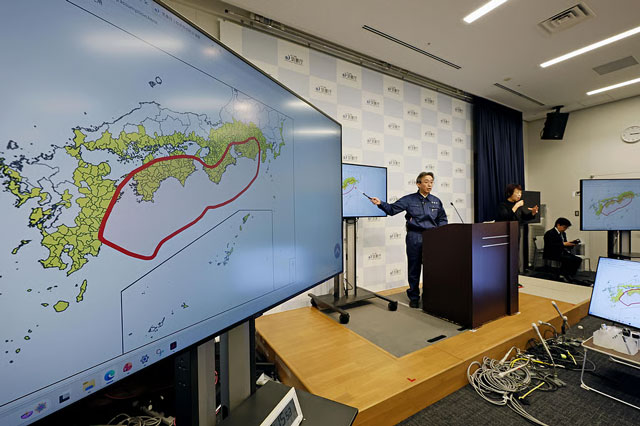
Speaking at a press briefing, JMA official Ayataka Ebita warned residents to exercise caution against secondary hazards, including landslides, falling rocks and mudslides, particularly if rainfall occurs in the affected regions. The agency advised people living in areas that experienced strong shaking to remain prepared for further seismic activity for approximately one week.
The earthquake also drew attention because its epicentre was within the Nankai Trough region, where scientists have long warned of the possibility of a major earthquake. However, officials clarified that no significant changes had been detected in the condition of the tectonic plate boundary following Sunday's tremor.
According to the meteorological agency, the earthquake did not indicate any particular change in the locked condition of the plates along the Nankai Trough. Authorities said they would continue closely monitoring seismic activity and ground movements in the region.
There was no tsunami threat from the earthquake. Meanwhile, Shinkansen bullet train services in the affected areas were operating at reduced speeds as a precautionary measure. Railway authorities adopted the safety measures because strong earthquakes can damage railway tracks and other infrastructure, potentially affecting train operations.
The Japanese government also initiated its emergency response arrangements following the earthquake.
Japan is among the world's most earthquake-prone countries because it lies along the Pacific Ring of Fire, where several tectonic plates meet and interact. The country regularly experiences seismic activity and has developed extensive disaster preparedness and emergency response systems.
Authorities routinely advise residents to maintain emergency supplies, including bottled drinking water, food, batteries and other essential items. People are also encouraged to prepare evacuation plans, identify safe places inside their homes and keep comfortable walking shoes readily available in case they need to leave their buildings during an earthquake.
Residents in the affected areas have been urged to remain vigilant and follow official safety advisories as monitoring of seismic activity continues.