Daijiworld Media Network - New Delhi
New Delhi, Jan 19: India’s rabi cropping season has recorded a significant expansion this winter, with the total sown area rising by 20.88 lakh hectares to 652.33 lakh hectares as of January 16, compared to 631.45 lakh hectares during the same period last year, according to data released by the Ministry of Agriculture and Farmers Welfare.
The wider acreage is expected to translate into higher crop output, offering relief on food prices while boosting farm incomes. Improved monsoon rainfall has played a key role, enabling sowing in rain-fed regions that account for nearly half of the country’s agricultural land.
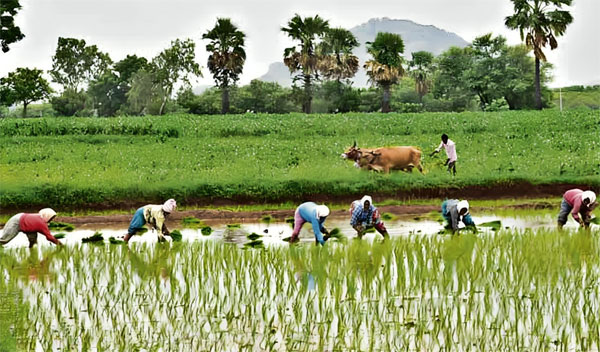
Wheat cultivation has seen a notable rise, with the area under the staple crop increasing by 6.13 lakh hectares to 334.17 lakh hectares. Pulses, including urd, masur, gram and moong, have also gained ground, with their combined acreage climbing by 3.82 lakh hectares to 137 lakh hectares.
Coarse cereals and millets such as jowar, bajra and ragi have expanded by 2.79 lakh hectares, taking their total coverage to 58.72 lakh hectares so far this season. Oilseeds, particularly rapeseed and mustard, have recorded an increase of 3.53 lakh hectares, reaching 96.86 lakh hectares.
To further support farmers, the Cabinet Committee on Economic Affairs approved a revision in minimum support prices (MSP) for all mandated rabi crops for the 2026–27 marketing season in October last year. The MSPs were announced well before the sowing period, enabling farmers to plan their crops more strategically.
Safflower received the highest MSP hike of Rs 600 per quintal, followed by lentil (masur) with an increase of Rs 300 per quintal. MSPs for rapeseed and mustard, gram, barley and wheat were raised by Rs 250, Rs 225, Rs 170 and Rs 160 per quintal, respectively.
These revisions align with the Union Budget 2018–19 commitment to set MSPs at a minimum of 1.5 times the all-India weighted average cost of production. As per official estimates, the expected margin over production costs stands at 109 per cent for wheat, 93 per cent for rapeseed and mustard, 89 per cent for lentil, 59 per cent for gram, 58 per cent for barley and 50 per cent for safflower.
The cost calculations factor in both paid and imputed expenses, including labour, machinery, leased land rent, inputs such as seeds and fertilisers, irrigation, fuel and electricity, depreciation, interest on working capital and the value of family labour. Officials said the enhanced MSP regime is aimed at ensuring fair returns to farmers while encouraging diversification across crops.