Media Release
Quepem, Feb 13: “Roman-script Konkani writers who are fighting for justice today cannot be labelled communal. During the Konkani agitation, we all fought together without script differences,” stated historian and researcher Sushila Sawant Mendes, former Head of the History Department at Government College Quepem.
She was speaking as the chief guest at the Global Konknni Forum during the ‘Global Konknni Forum Awards 2026’ ceremony held on its First Foundation Day at the Ravindra Bhavan (Black Box), Margao.
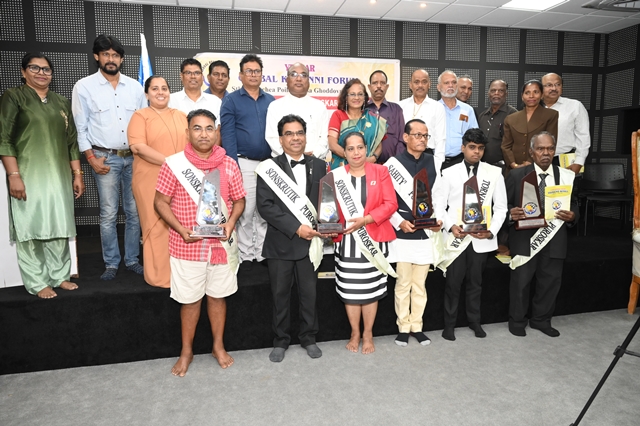
Manuel Fernandes (Literary) RJ Roque Vaz and RJ Bihula Vaz (Cultural - International Level); Marius Fernandes (Cultural- National Level), Natividade De Sa (‘Konknni Seva’) and Joshua Rocha Pereira (Youth) were conferred Global Konknni Forum Awards 2026.
Prof Mendes said that for several decades, major contributions to the Konkani language have come from Roman-script writers in Goa and abroad. She added that branding Roman script as belonging only to Catholics is unjust and divisive.
Prof Mendes criticised the Goa Government’s rule requiring compulsory knowledge of Konkani in the Devanagari script to secure government jobs. She pointed out that candidates appearing for lecturer interviews at Goa University are rejected merely because they cannot write their name or home address in Devanagari.
She said this criterion marginalises a significant section of Goan society. “Those with expertise in their subject deserve an equal chance. Denying them opportunities simply because they cannot write in Devanagari is injustice,” she stated.
Calling India a land of diversity and multilingualism, she reiterated that governments must listen to minority voices. She emphasised that Catholics constitute a linguistic minority in Goa and their concerns require attention.
Prof Mendes questioned senior Konkani writer Adv Uday Bhembre’s repeated assertion that the Portuguese banned Konkani in 1618, leading to no publications in the Roman script. “There were no Devanagari-script Konkani books published during that era either,” she remarked.
She noted that since 1889, numerous Roman-script Konkani books have been published, yet they are not considered for Sahitya Akademi awards because the script lacks official recognition in both the Akademi and the Goa Official Language Act.
Prof Mendes acknowledged that Konkani identity is preserved through tiatr by tiatrists, by priests and the Church through religious services, and by others across various fields. However, she emphasised that sustainable preservation of a language or script requires government support.
She reminded that the United Nations has declared 2022–2032 as the Indigenous Languages Decade, urging nations to protect indigenous languages. “When such an international body calls for preserving indigenous languages, why is the Goa Government reluctant to preserve Konkani in the Roman script?” she questioned.
Fr Pio Furtado, headmaster of Fr Agnel High School, served as the guest of honour. In his address, he observed that contemporary society is increasingly neglecting the Konkani language in favour of other languages, thereby distancing itself from its cultural and linguistic roots.
Commending the dedicated efforts of the Global Konknni Forum over the past eighteen months, he appealed to the Forum to intensify its outreach in rural areas so that a greater number of young people may be drawn closer to Konkani. He stressed that without the active involvement of the youth in safeguarding the language, the community risks losing an essential part of its identity in the future.
The function was presided by the Global Konknni Forum president Antonio Alvares. Secretary Jose Salvador Fernandes welcomed the gathering, and forum’s executive member and accomplished Roman script Konkani writer Jasmina Rodrigues expertly compered the function.