Daijiworld Media Network – Islamabad
Islamabad, Mar 22: Amid the ongoing conflict involving the United States and Israel, a controversial statement by former Pakistan High Commissioner to India Abdul Basit has raised fresh concerns over regional security.
Speaking during a discussion based on a hypothetical conflict scenario, Basit, who served in New Delhi from 2014 to 2017, suggested that if the US were to attack Pakistan, Islamabad could consider targeting Indian cities such as Mumbai and Delhi.
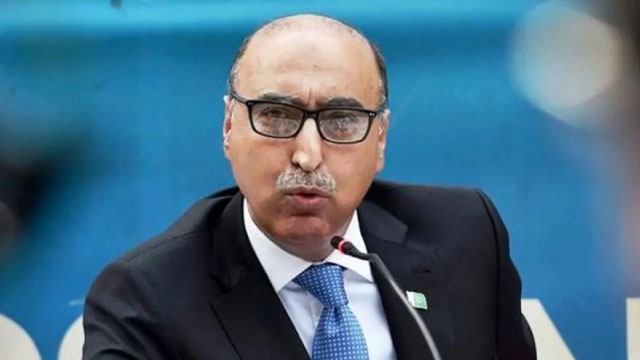
“Let’s assume that if the US attacks Pakistan, Pakistan should drop bombs on Mumbai and Delhi,” he said, adding further contentious remarks during the debate.
Basit argued that in a worst-case scenario, Pakistan may have no option but to retaliate against India, even if New Delhi is not directly involved in the conflict. His comments have been widely criticised as provocative and irresponsible, particularly in the backdrop of rising geopolitical tensions.
Elaborating on his position, Basit said that if tensions escalate further—such as a worsening conflict involving Iran and Israel—or if the US attempts to target Pakistan’s nuclear programme, Islamabad may be left with limited strategic options. In such a scenario, he claimed, India could become a fallback target if Pakistan is unable to strike US or Israeli positions.
The remarks come shortly after a US intelligence assessment flagged Pakistan as a potential nuclear threat. On March 18, the Office of the Director of National Intelligence released its 2026 Annual Threat Assessment, identifying Pakistan alongside major powers such as Russia and China in terms of nuclear capability concerns.
US intelligence chief Tulsi Gabbard, while presenting the report, highlighted Pakistan’s evolving military capabilities, including the development of advanced missile delivery systems. The assessment noted that Pakistan is working on long-range ballistic missiles that could potentially evolve into intercontinental systems capable of reaching the United States.
Basit’s remarks, coupled with the findings of the report, have intensified debate over regional stability and the risks of escalation in an already volatile geopolitical environment.