Daijiworld Media Network - Mangaluru
Mangaluru, Apr 3: The Mangaluru City Corporation (MCC) has commenced implementation of the revised Solid Waste Management Rules 2026, which came into force across the country on April 1, making four-way segregation of waste at source mandatory and tightening compliance norms across the city.
Replacing the earlier two-bin system of wet and dry waste, the MCC has directed all households and establishments within its jurisdiction to segregate waste into four categories before handing it over to collection teams.
Under the new system, green bins are designated for wet waste such as kitchen refuse, fruit and vegetable peels, leftover food, meat waste, flowers and leaves.
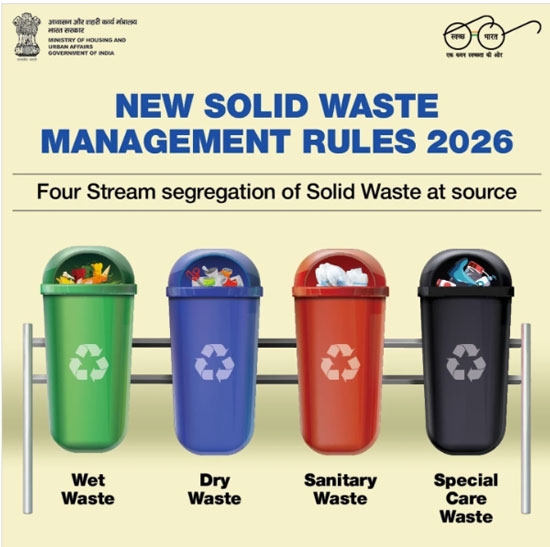
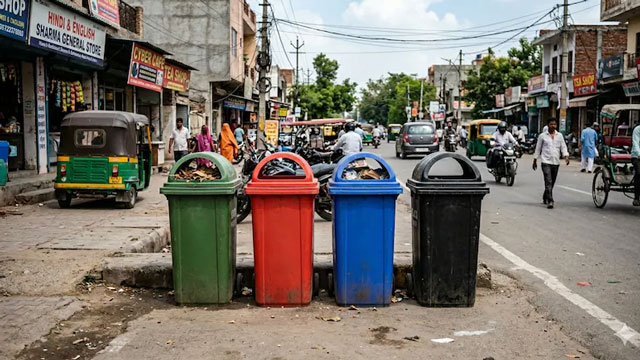
Blue bins are meant for dry waste including plastic, paper, cardboard, glass, metal and rubber. Red bins are to be used for sanitary waste such as diapers, sanitary pads, condoms and bandages, while black bins are assigned for domestic hazardous or special care waste such as batteries, LED bulbs, tube lights, paint containers, pesticide bottles, thermometers, medicines and e-waste.
MCC Commissioner Ravichandra Naik said wet and sanitary waste will be collected on a daily basis, while dry and hazardous waste will be collected once a week, specifically on Fridays. He added that garbage collection vehicles are being redesigned with four separate compartments to ensure that segregated waste is not mixed during transportation.
The revised rules place strong emphasis on segregation at source, with sanitation workers authorised to refuse collection if waste is not properly sorted. The MCC has warned that violations will attract penalties under the Solid Waste Management Bye-laws, 2019, in accordance with the “polluter pays” principle.
The civic body has also introduced stricter norms for bulk waste generators. Establishments generating more than 100 kilograms of waste per day, or having a built-up area exceeding 20,000 square metres — including offices, shopping malls, hospitals and large residential complexes — as well as those consuming over 40,000 litres of water daily, will be classified as bulk generators. Such entities are required to process wet waste within their own premises and comply with enhanced regulatory standards.
Officials said the move is aimed at improving waste processing efficiency, reducing the burden on landfills and ensuring environmentally sound disposal practices. Municipal infrastructure is being upgraded to support the new system, while the Central Pollution Control Board has introduced an online monitoring mechanism to track compliance.
Calling for public cooperation, the MCC has urged residents to strictly adhere to the four-bin segregation system. Citizens have been advised to contact or visit the MCC Health Department during office hours for further information.
In a parallel initiative to promote sustainability, the MCC has launched a ‘green marriage’ concept to encourage zero-waste celebrations. Commissioner Ravichandra Naik recently felicitated Veerendar and Suraksha, who conducted an eco-friendly wedding at Rajatadri auditorium in Vamanjoor on March 30.
In a post on its X handle, the MCC stated, “The wedding embraced a zero waste, plastic free and eco friendly concept.”
At the ceremony, plastic bottles were avoided, with guests served water and refreshments in steel tumblers. Tissue paper was not used, ice cream was served in arecanut leaf cups, and decorations featured flowers and reusable eco-friendly materials, setting an example for sustainable events in the city.