Daijiworld Media Network - New Delhi
New Delhi, Apr 18: The Supreme Court on Friday observed that judges must rise above personal religious beliefs and be guided by freedom of conscience and the constitutional framework while deciding matters of faith, noting that religious practices are open to judicial scrutiny.
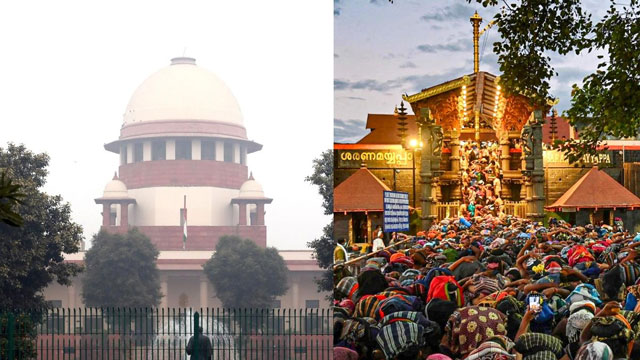
A nine-judge Constitution Bench made the remarks while hearing the Sabarimala temple entry case, which involves a review of the 2018 verdict that lifted restrictions on women aged 10 to 50 years entering the temple.
During the hearing, senior advocate Rajeev Dhavan, appearing for an intervenor, argued that the issue extends beyond Sabarimala and Hindu practices and concerns the broader constitutional framework governing all religions and matters of conscience.
“The concern is to lay down the law for everybody, every belief and every matter of conscience,” Dhavan said, adding that courts must seek to harmonise divisions in society.
At this point, the bench raised questions on the relationship between conscience and religion, with Justice B V Nagarathna asking whether conscience is larger than religion, and Justice Sandeep Mehta questioning whether judges should rise above personal beliefs to balance constitutional principles.
Dhavan responded that it is for the court to interpret the concept of conscience as it deems appropriate.
Representing the Sabarimala Achara Samrakshna Samiti, senior advocate V Giri argued that long-standing religious practices excluding women aged 10 to 50 from the temple form part of its essential character.
He submitted that every temple has its own traditions, and maintaining them is integral to worship and religious practice. Giri also argued that Article 25(1) of the Constitution protects the right to practice religion, including idol worship, in accordance with established customs.
Senior advocate M R Venkatesh, appearing for Atman Trust, argued that the practice of women voluntarily abstaining from entering temples during menstruation is rooted in discipline and belief rather than discrimination.
He said such practices are followed by many women in South India as a matter of personal discipline, describing them as unwritten customs based on faith.
In its landmark 2018 verdict, a five-judge Constitution Bench had by a 4:1 majority allowed women of all ages to enter the Sabarimala temple, holding that the earlier restriction was unconstitutional. In 2019, the issue was referred to a larger bench for reconsideration.
The nine-judge bench is expected to continue hearing the matter in the coming days, with its final ruling likely to have wider implications on the balance between religious practices and constitutional rights across faiths.