Daijiworld Media Network - Panaji
Panaji, Oct 3: Goa's implementation of the new Solid Waste Management Rules, 2026 has begun taking shape, with Mormugao Municipal Council becoming the first of the state's 13 municipalities to introduce four-way door-to-door waste collection.
The system requires waste generators to segregate waste at source into four categories — wet, dry, sanitary and special-care waste. The rules came into force on April 1, 2026, and require local bodies to ensure door-to-door collection of segregated waste from households, commercial establishments, institutions, housing complexes and other premises.
Mormugao has already been implementing the four-way collection system for the past two months, Municipal Engineer Augustino Misquita said.
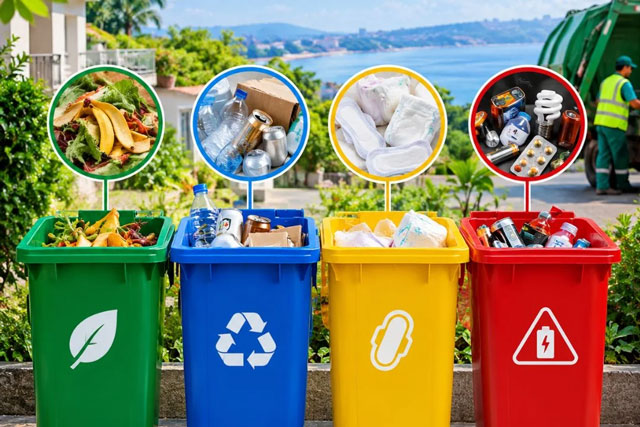
“We have begun collecting door-to-door segregated waste in four ways two months back in Mormugao council,” Misquita said.
Under the system, green bins are meant for wet or biodegradable waste, including kitchen waste, food scraps and vegetable and fruit peels. Blue bins are for dry and recyclable material such as paper, plastic, metal, glass and rubber. Red bins are meant for sanitary waste, while black bins are for special-care waste requiring separate handling, including batteries, expired medicines, bulbs and other household hazardous material.
Mapusa Municipal Council is preparing to introduce the same system. Misquita, who also holds the additional charge of Municipal Engineer of Mapusa Municipal Council, said the civic body would begin four-way collection “very soon”.
The rollout in Mapusa would be the next significant step in bringing Goa's urban local bodies in line with the new waste-management regime. At present, Mormugao is understood to be the only municipality in the state to have started four-way door-to-door collection.
Misquita said the Corporation of the City of Panaji was already “well ahead” in garbage collection and was among the better-performing civic bodies in the country.
The rural sector, however, is yet to make the transition. Director of Panchayats Dashrath Redkar said the Directorate would shortly issue directions to panchayats across the state to begin collection in accordance with the new rules.
The 2026 rules apply to both urban and rural local bodies and place greater emphasis on source segregation, scientific processing, accountability and the circular economy. They also include stronger provisions concerning bulk waste generators and environmental compensation for non-compliance.
The state government has identified four-way segregation as a key part of its implementation strategy, with green for wet waste, blue for dry waste, red for sanitary waste and black for special-care waste.
With the new rules now in force, the experience of Mormugao is expected to provide a ground-level model for other municipalities and panchayats as Goa moves from the traditional wet-and-dry segregation system to the mandatory four-stream model.