Media Release
Bengaluru, Dec 10: St Joseph’s University has inaugurated the Centre for Religion and Culture (CRC), a pioneering research initiative dedicated to documenting, archiving, and critically studying the historical, cultural, and intellectual contributions of Christian missionaries, scholars, and institutions to Karnataka and India. The inauguration, held on December 8, marks a significant milestone for the university and for Christian heritage research at a time when historical records face systematic erasure and the need for careful preservation has become urgent.
The ceremony was attended by a distinguished gathering that included Archbishop Peter Machado of Bengaluru, Prof S Japhet, chairperson of the Karnataka Christian Community Development Corporation; Fr Dionysius Vaz, S J, Provincial of the Karnataka Jesuit Province, Dr (Fr) Victor Lobo, S J, vice-chancellor of St Joseph’s University, Dr (Fr) Melwyn Pinto, S J, acting superior of Arrupe Nivas, Dr (Sr) Deepthi, secretary general of the Xavier Board of Higher Education in India; historian and writer Alan Machado Prabhu; and Dr (Fr) Bala Kiran Kumar Hrudayaraj, S J, the director of CRC. Dr Bala Kiran welcomed the gathering and articulated the vision of the centre as a space where rigorous scholarship, cultural memory, and public engagement meet.
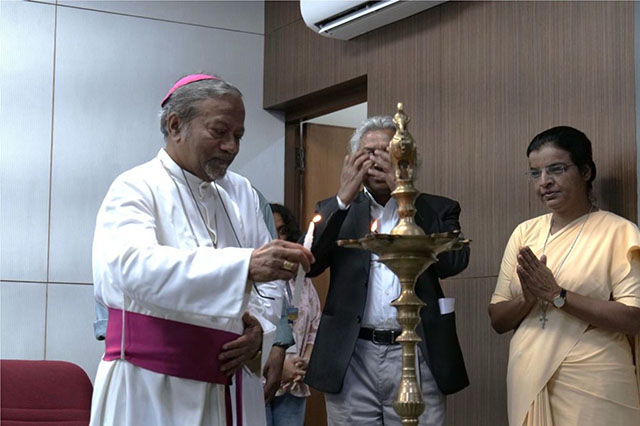
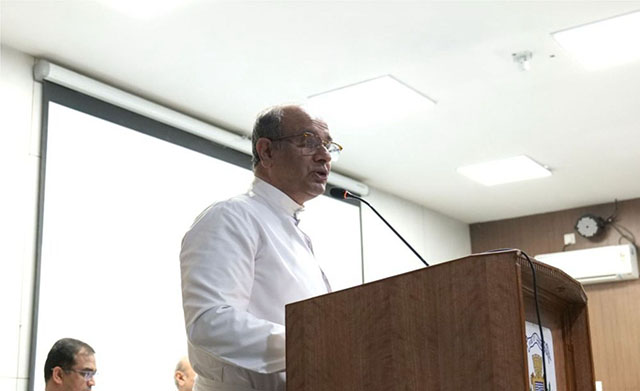


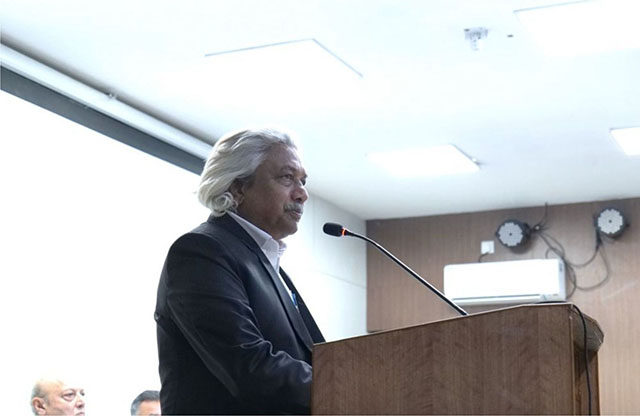
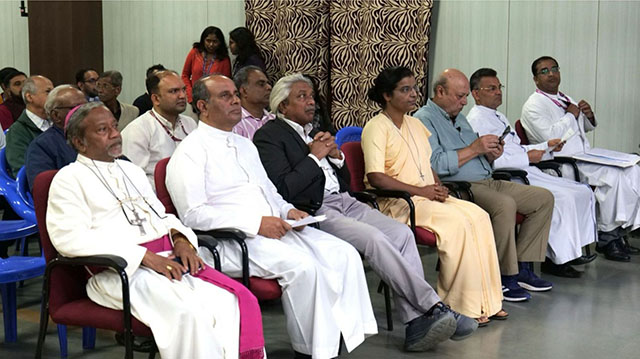
Archbishop Dr Peter Machado, in his address to the gathering, highlighted five significant dimensions of the Centre. He emphasized that the Centre serves as a repository of Christian heritage and memory, preserving the rich legacy of the community. Secondly, the Centre is envisioned as a space that fosters unity and harmony, promoting dialogue and understanding across traditions.
Thirdly, the Archbishop noted that the centre is not merely a research institution but a living classroom, where life experiences intersect with scholarly ideas. Fourthly, the centre aims to help communities recover the roots of their identity. And finally, it encourages them to reach outward and look ahead to new possibilities.
In his address, Prof Japhet described the establishment of CRC as an important milestone for Karnataka and observed that its full impact on India’s intellectual and cultural landscape may only become clear in the years to come. He stressed that India’s development trajectory in education, healthcare, and social transformation cannot be understood without acknowledging the foundational contributions of Christian communities.
Archbishop Peter Machado, whose vision initiated the creation of the centre three years ago, spoke of the urgency of preserving historical memory. He noted that in an age when facts, documents, and cultural roots are rapidly disappearing, institutions like CRC become essential guardians of truth and heritage.
Vice-chancellor Fr Victor Lobo emphasized that with the inauguration of CRC, St Joseph’s University enters a moment of historical significance.
Highlighting the Centre’s role in fostering scholarship and public dialogue, he proposed three guiding principles: knowledge dispels fear, dialogue nurtures peace, and heritage demands responsibility. He called upon students and scholars to engage deeply with the archives and histories that shape Karnataka’s social fabric. Provincial Fr Dionysius Vaz, S J, underlined the importance of the Centre by describing it as one of the cultural frontiers that Jesuits are invited to engage with, echoing the vision of Pope Leo XIII for intellectual and cultural commitment.
The Centre for Religion and Culture is envisioned as a vibrant research hub committed to uncovering, preserving, and presenting Christian heritage in conversation with the wider Indian context. It seeks to build an extensive archival and digital repository, nurture scholarly research, foster interreligious and intercultural dialogue, and eventually develop a museum that showcases the rich and diverse Christian contributions to Karnataka.
Outlining the immediate roadmap, Dr Bala Kiran Kumar presented a six-month action plan that includes establishing the archival infrastructure, initiating research projects and history programmes, forming academic collaborations, organizing public lectures and workshops, and laying the foundation for future educational programmes under the Centre.
A comprehensive view of Centre for Religion and Culture
The current juncture in India and in Karnataka, marked by challenges to the country’s multi-religious and multi-cultural heritage, makes the establishment of this initiative both relevant and necessary. Nevertheless, the vision of the centre must not be defensive; rather, it is broad, academic, and professional, ecumenical, secular, scholarly, scientific, historical, sociological, and critical. Its primary focus is on examining the history and impact of Christian missions, missionaries, Churches, communities, institutions, scholars, and eminent personalities on Karnataka’s society and culture in particular, and on India more broadly.
The main objective of the centre is to research, document, preserve, and disseminate the significant contributions of the Christian community to Karnataka’s culture, language, and society. With a strong emphasis on scholarly pursuit across diverse fields, the centre seeks to build a comprehensive library and archival facility to safeguard this valuable heritage, and, when possible, to establish a museum. It also aims to be a teaching institution offering certificate, diploma, undergraduate, and graduate programmes in relevant areas.
The centre will regularly organize guest lectures, workshops, and seminars that bring together academics, religious groups, secular thinkers, civil society actors, government representatives, and policymakers. Furthermore, the centre intends to engage actively in interreligious dialogue and to promote interreligious harmony, an endeavour that is especially vital in the present times.
Action plan and collaboration
The Centre for Religion and Culture entered a new phase of renewed vision and dynamic action three months ago. In this short span, the CRC has gained remarkable momentum, forged strong partnerships, and laid the foundation for a statewide and international research network. The CRC hosted its first working committee meeting, bringing together thirty-two eminent scholars from across Karnataka, including historians, linguists, sociologists, theologians, philosophers, and artists and marking the formal beginning of the Centre’s collaborative academic journey on October 16.
During this meeting, the CRC was designated as the Nodal Centre for research, documentation, and collaborative engagement on Christian contributions to Karnataka’s cultural and intellectual life. A significant outcome of the meeting was the establishment of a close working partnership with the Karnataka Christian Community Development Corporation (KCCDC), under the leadership of Prof S Japhet, strengthening the Centre’s institutional support and outreach.
As the Nodal Centre, the CRC coordinates with three Regional Centres representing Karnataka’s major revenue divisions, each in collaboration with partner institutions and regional coordinators. The Mangalore–Mysore Region works with the Karnataka Theological College (KTC) and St Aloysius (Deemed-to-be University), under the coordination of Dr Watson and Dr Mona Mendonca. In the Hubli–Belgaum Region, CRC collaborates with Kittel College, Dharwad, coordinated by Dr Rekha Jogul. The Raichur–Kalaburagi Region is coordinated by Christopher, extending the Centre’s reach into the Hyderabad–Karnataka belt. Additional collaborations are being explored with Dharmaram Vidya Kshetram (DVK), St Peter’s Pontifical Seminary, St Joseph’s Seminary, United Theological College (UTC) and Suvidya College, further enriching the Centre’s statewide academic network.
Beyond Karnataka, the CRC is building strong national alliances with the Jesuit Centre for Indian and Indo-Christian Studies in Goa, Vidyajyoti College of Theology in Delhi, and Jnana Deep, the Pontifical Institute of Philosophy and Theology in Pune. These collaborations will enable joint publications, visiting lectures, and shared academic initiatives. Internationally, the CRC is in advanced dialogue with Sophia University (Tokyo), the University of Vienna and the University of Innsbruck (Austria), the University of Tubingen (Germany), Fordham University (New York), and the Ricci Institute at Boston College. These partnerships aim to facilitate exchanges, expand archival resources, promote joint research, and develop shared academic programmes, strengthening the Centre’s global presence.
In the immediate future, the CRC has formulated a six-month action plan centred on five major initiatives. These include a five-lecture series on ‘The Historical Evolution of Christianity in Karnataka,’ the establishment of the Karnataka Christian Women Writers & Scholars Forum, the creation of the Karnataka Christian Artists Forum, and the formation of a multidisciplinary Think Tank of Scholars in Humanities whose first project will be revising the seminal booklet My Landa and My People. In July, the centre plans to host a national conference on ‘Christian Contributions to Nation Building: Freedom Struggle, Facts and Fictions,’ exploring the historical and contemporary role of Christian communities in India’s socio-political development.
Looking further ahead, the CRC’s long-term aspiration is the establishment of a School of Comparative Religion dedicated to advanced scholarship in anthropology, cosmology, theology, and ontology, while also serving as an important hub for interreligious dialogue and comparative studies. The centre is already in discussion with a distinguished panel of scholars, including Prof S Japhet, Prof Valerian Rodrigues, Prof Virendra Chennai, Fr Francis X Clooney, S J, Fr James Keenan, S J, Fr Felix Korner, S J, and Fr Patrick of the Kota diocese, who may serve on its expert committee. Together, these developments reflect the CRC’s expanding vision, rooted in rigorous scholarship, collaborative partnerships, and a deep commitment to preserving and interpreting the rich Christian heritage of Karnataka.