Daijiworld Media Network - New Delhi
New Delhi, Jun 14: Union Minister Ashwini Vaishnaw has said India is likely to attract fresh investments in memory chip manufacturing, while existing investors are expected to expand production capacities to address the growing global demand-supply gap in the semiconductor sector.
Vaishnaw said the rapid growth of artificial intelligence (AI) and data centres has created an unprecedented shortage of critical semiconductor components, particularly high-bandwidth memory chips.
"Definitely, a lot more investment is coming into memory manufacturing units. For the first time, as the semiconductor industry has grown at such a rapid pace, we are witnessing a huge shortage of certain components required in AI data centres, especially high-bandwidth memory chips," he said.
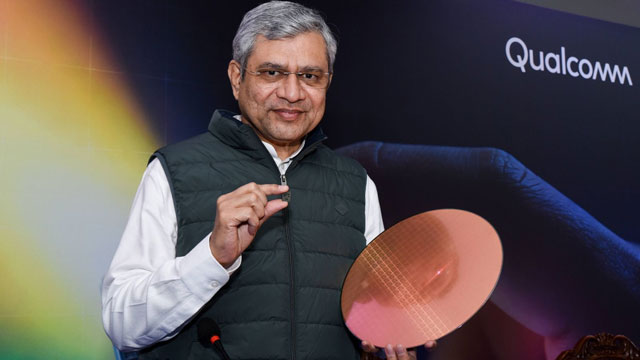
The minister noted that India is emerging as an important destination for semiconductor investments as global manufacturers seek to expand production capabilities amid rising demand.
According to industry estimates, investments in India's data centre sector are expected to exceed USD 200 billion in the coming years, creating substantial demand for advanced memory and storage solutions.
Vaishnaw pointed to the operations of Micron Technology, which began commercial production in India earlier this year, as evidence that efforts to strengthen the domestic semiconductor ecosystem are already yielding results.
He said the shortage of memory chips remains a global phenomenon and that both new investors and existing manufacturers are likely to participate in capacity expansion.
When asked whether future growth would come from new entrants or current players, the minister replied that both possibilities appeared likely.
Highlighting the government's semiconductor roadmap, Vaishnaw said the India Semiconductor Mission (ISM) 2.0 is in an advanced stage of planning and will place significant emphasis on semiconductor design and manufacturing equipment.
Under the next phase of the programme, the government intends to encourage global equipment manufacturers to establish both design and manufacturing operations in India.
He also said that indigenous production of specialised chemicals and industrial gases used in semiconductor fabrication would be a priority under the expanded mission.
The minister noted that ISM 1.0 helped lay the foundation for India's semiconductor ambitions by attracting major investments and supporting nearly 48 startups engaged in semiconductor and technology development.
"Design will be the topmost priority in ISM 2.0. The second major focus area will be machines and equipment used in semiconductor manufacturing," he said.
Vaishnaw added that the government would continue promoting the establishment of additional fabrication plants and Assembly, Testing, Marking and Packaging (ATMP) units while expanding efforts in talent development.
Speaking about India's growing appeal as a data centre hub, the minister identified three key advantages: a large pool of skilled professionals, a modern and robust power transmission network, and abundant renewable energy capacity.
He said more than two lakh kilometres of transmission lines have been built in the past decade, significantly strengthening India's power infrastructure.
According to Vaishnaw, nearly half of the country's installed power generation capacity now comes from renewable energy sources, making India an attractive destination for global hyperscale data centre operators.
The minister also addressed environmental concerns surrounding the sector, stating that strict regulatory standards are being followed and that technological innovations are helping reduce water and energy consumption.
He said newer cooling technologies can cut water usage by nearly 70 per cent, helping improve the sustainability of large-scale data centre operations.
Industry studies estimate that water consumption by data centres in India could rise from about 150 billion litres in 2025 to more than 358 billion litres by 2030, underscoring the importance of sustainable infrastructure planning as the sector expands.