Mangalore IAS - Current Affairs 2026

India Ranks 13th in QS World Future Skills Index 2027
India has secured the 13th position in the QS World Future Skills Index of 2027 and it highlights the country’s growing readiness for the artificial intelligence-driven future. The The latest report which was released by the global higher education analytics firm QS has recognizes the India as one of the strongest-performing lower-middle-income economies in preparing for the AI-led economic transformation.
The top three countries in the QS World Future Skills Index 2027 are the,
- United States
- Australia
- United Kingdom
With the 13th Place India is among the world’s stronger performers and ahead of the many emerging economies
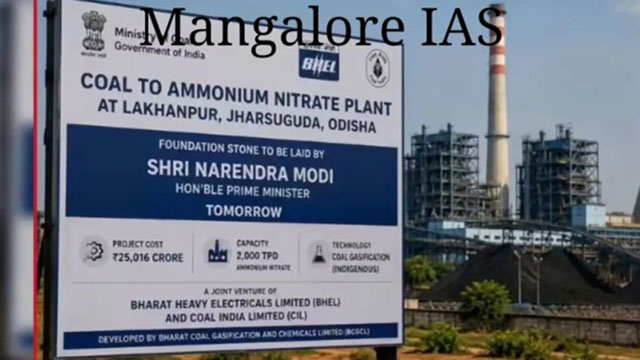
PM Modi to Lay Foundation Stone of India's First Commercial-Scale Coal-to-Ammonium Nitrate Project in Odisha.
Landmark Project for the India’s Industrial Future
The Lakhanpur coal gasification project marks the first commercial-scale facility in the India that will convert the coal into ammonium nitrate using indigenous technology.
The project will be developed by the Bharat Coal Gasification and Chemicals Limited (BCGCL), and it is a joint venture between the,
- Bharat Heavy Electricals Limited
- Coal India Limited
The facility will have the capacity to produce the 2,000 tonnes of ammonium nitrate per day and it creates the domestic source of the important industrial chemical currently dependent on the imports and conventional feedstocks.
What Is Coal Gasification?
Coal gasification is the advanced industrial process that converts coal into the synthesis gas which is commonly known as the syngas.
Syngas primarily contains the,
- Hydrogen
- Carbon monoxide
- Other gaseous compounds
This gas can then be processed to manufacture the several value-added products which includes the,
- Methanol
- Urea
- Ammonium nitrate
- Synthetic natural gas
- Chemical feedstocks
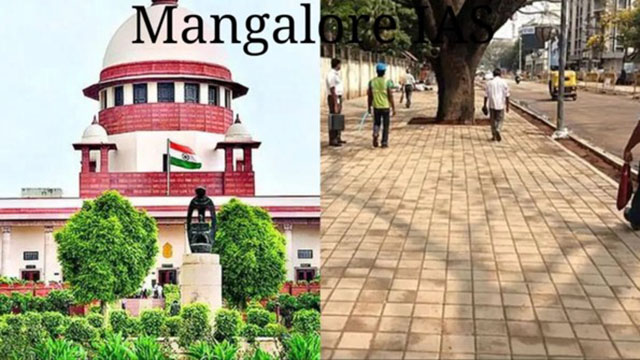
Supreme Court Declares Right to Walk on Safe Footpaths a Fundamental Right.
A bench comprising Respectable Justice P. S. Narasimha and Respectable Justice Atul S. Chandurkar held that the right to walk is the fundamental right which is protected under Part III of the Constitution.
According to the court, this right is closely linked to the,
- Article 19(1)(d): Freedom of movement
- Article 19(1)(a): Freedom of expression
- Article 19(1)(b): Right to assemble peacefully
- Article 19(1)(c): Right to form associations
- Article 21: Right to life and personal liberty
The court have emphasized that the right to walk naturally includes the right to access safe, demarcated and well-maintained footpaths.
Case That Led to the Landmark Judgment
The ruling came from a motor accident compensation case which involves a five-year-old boy.
The child was walking to school with his father when a tanker hit him from behind and it caused the fatal injuries.
The Supreme Court noted that the road where the accident occurred lacked the footpath and a pedestrian crossing.
While the Motor Accident Claims Tribunal had awarded the compensation, the High Court later reduced it.
The Supreme Court restored and it enhanced the compensation to Rs 11.44 lakh and directed to payment within two months.

France to Get First Traditional Hindu Temple Built with Indian Stones.
Significance for the Indian Diaspora
For the Indian community who are living in France, this temple represents much more than a religious structure.
It serves as the,
- A center for the spiritual practice
- A symbol of cultural identity
- A place for community gatherings
- A venue for preserving Indian traditions and values
- A platform for the cultural education for future generations
The temple is expected to become the important hub where people can celebrate the festivals, participate in religious activities and strengthen the community bonds.

Uzbekistan Becomes First Central Asian Member of New Development Bank.
Uzbekistan has officially become the first Central Asian country to join the New Development Bank (NDB) and it marked the significant milestone in the expansion of the BRICS backed multilateral financial institution.
The Republic of Uzbekistan formally became the shareholder of the NDB on 5th of June, 2026 after completing all the necessary accession procedures and ratifying the bank’s Articles of the Agreement.
Question and Answers:
QUESTION 1
Select the correct sequence of mathematical signs that can sequentially replace the “@” signs and balance the given equation.
32 @ 10 @ 155 @ 475 @19 @ 190
- ×, −, +, ÷, =
- ×, ÷, −, +, =
- ÷, +, ×, =, +
- +, −, =, ×, ÷
ANSWER 1
32 @ 10 @ 155 @ 475 @19 @ 190 On checking option (a):
32 × 10 − 155 + 475 ÷19 = 190 Or, 320 − 155 + 25 = 190
Or, 345 – 155 = 190
Or, 190 = 190
LHS = RHS
Hence, option (a) is correct.
QUESTION 2
A Question is given below followed by two Statements I and II. Question: In how many days can B alone complete the work?
Statement I: A and B together can complete the same work in 18 days. Statement II: B and C together can complete the same work in 24 days.
Which one of the following is correct in respect of the above Question and the Statements?
a) The question can be answered by using either statement alone, but cannot be answered using the other statement alone.
b) The question can be answered by using either statement alone.
c) The question can be answered by using both the statements together, but cannot be answered using either statement alone.
d) The question cannot be answered even by using both the statements together.
ANSWER 2
Statements I and II alone cannot be used to find the answer.
Using statements I and II together:
LCM of 18 and 24 = 72
Efficiency of A + B Statements I and II alone cannot be used to find the answer. Using statements I and II together:
LCM of 18 and 24 = 72
Efficiency of A + B
72 / 4 = 18 (units/day)
Efficiency of B + C
72 / 3 = 24 ( units/day )
We cannot find individual efficiency of anyone using the above equations. Hence, option (d) is correct.
QUESTION 3
Ramu sold one kg of Basmati rice for Rs. 152 and suffered a 5% loss. Had he sold it for Rs. x more, he would have got a profit of 15%. Which one of the following is correct?
- Rs. 30 < x < Rs. 35
- Rs. 40 < x < Rs. 45
- Rs. 25 < x < Rs. 30
- Rs. 35 < x < Rs. 40
ANSWER 3
Given that: Selling price = Rs. 152
Loss = 5%
Then cost price = (152/95) × 100 = Rs. 160
Now, the cost price remains the same in both cases.
So, when profit is 15%, then selling price = (160 × 115) /100 = Rs. 184 Hence, x = 184 – 152 = Rs. 32
Hence, x lies between 30 and 35.
Hence, option (a) is correct.