Daijiworld Media Network - New Delhi
New Delhi, Oct 8: Artificial intelligence-native networks and 6G technologies have emerged as major focus areas at the 10th edition of the India Mobile Congress (IMC) 2026, where telecom operators and network equipment makers are showcasing technologies aimed at automated network management, AI workloads and next-generation connectivity applications.
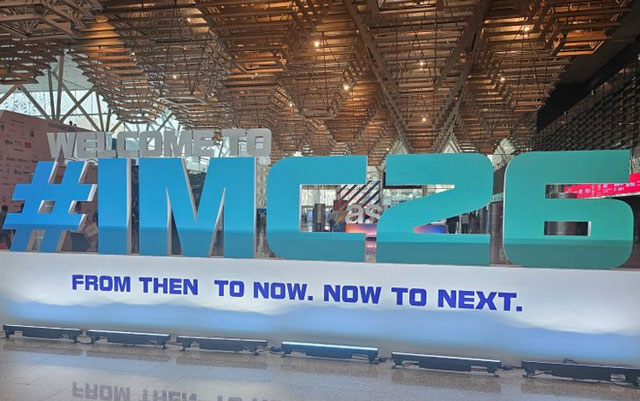
The four-day event, being held in New Delhi from October 7 to 10, features 5G, 6G and next-generation AI networks among its key technology sectors. The event also includes the third International 6G Symposium, with discussions centred on AI-native networks, intelligent radio access networks (RAN), autonomous networks and the development of 6G technologies.
Reliance Jio is showcasing AI-based network technologies and connectivity solutions, including its approach of integrating AI directly into the telecom network. Its Jio Call Agent demonstration brings a native AI voice agent into the Jio network, allowing customers to access the service during a phone call without using a separate application. The company said the system is designed to work across Indian languages and operates with user consent.
Jio is also demonstrating AI-native network management, satellite connectivity technologies and capabilities aimed at future mobile networks. The company has separately said it is developing an indigenous satellite technology stack and has filed patents in the pre-6G space. It is also working on AI-based voice and data services as part of its next-generation network initiatives.
Bharti Airtel is focusing on network intelligence, cloud infrastructure and security at the event. Airtel Business has launched IQ Gateway, a platform that brings SMS, WhatsApp, RCS and business voice communications onto a single control plane.
The platform uses network-level information for delivery reporting, authentication and fraud protection. Its Silent Authentication feature uses network and SIM information to verify whether a phone number matches the active SIM in a device, potentially replacing OTP-based verification in supported login and SIM-binding processes.
Sharat Sinha, CEO, Airtel Business, said embedding trust at the network layer would help enterprise customers, including banks, government departments and logistics companies, reduce cybercrime losses and strengthen the credibility of customer interactions.
Airtel is also participating in discussions on 6G foundations and zero-touch networks. Its wider showcase includes sovereign cloud infrastructure, AI-based security operations and the use of AI to manage energy consumption in data centres.
Vodafone Idea (Vi) is showcasing AI applications and intelligent connectivity solutions, including AI-based customer services, enterprise applications, private 5G, edge computing and connected mobility. Its demonstrations include industrial applications in mining, where private 5G and edge computing are combined with AI-based analytics.
Vi is also demonstrating AI-based security operations and solutions that combine AI and the Internet of Things for agriculture, reflecting the operator's focus on applying AI to telecom and enterprise networks.
Ericsson is showcasing AI-enabled RAN, agentic AI and network automation. Its demonstrations include AI-powered RAN architecture for traffic management and positioning, while agentic AI is being used to automate decision-making in network operations.
The company is also demonstrating AI-powered rApps for RAN deployment, optimisation, assurance and self-healing, along with 5G Advanced capabilities such as enhanced uplink, lower latency, accurate positioning and dynamic network slicing.
Nitin Bansal, MD, Ericsson India, said the company's demonstrations show how 5G and AI can provide a platform for innovations in healthcare, agriculture, manufacturing and digital inclusion.
Ericsson's 6G showcase includes collaborative robots operating in a warehouse environment, combining connectivity, sensing, edge computing and AI for navigation and other tasks.
Nokia is positioning AI as an integral part of network architecture as the industry moves towards 6G. Its mobile core portfolio is evolving from cloud-native to AI-native infrastructure, incorporating machine learning, large language models, agentic AI and edge inference.
The company said AI can support predictive operations, anomaly detection, self-healing and intent-driven autonomous operations as networks progress towards 5G-Advanced and 6G. Nokia is also participating in discussions on 6G standards, intelligent RAN and autonomous networks at IMC.
India's role in the development and standardisation of 6G is also receiving attention at the event. The Bharat 6G Alliance is working on technology, spectrum, use cases and intellectual property, while the government has set a target for India to contribute 10 per cent of global 6G patents.
The technologies being demonstrated at IMC 2026 indicate that development towards 6G is already taking place through advances in 5G Advanced and 5G standalone networks. AI-based RAN management, network slicing, edge computing, positioning and network automation are among the technologies being developed as the telecom industry prepares for the next generation of mobile connectivity.