Daijiworld Media Network - Mysuru
Mysuru, Oct 11: The 417th Mysuru Dasara celebrations commenced on Sunday with religious fervour and traditional grandeur, marking the beginning of the 11-day Navaratri festivities in the city of palaces.
Gavisiddeshwara Mahaswamiji of Koppal’s Gavimath inaugurated the celebrations by offering flowers to the festival idol of Goddess Chamundeshwari atop Chamundi Hills in the presence of chief minister D K Shivakumar and several state ministers.
The formal inauguration coincided with the beginning of Navaratri and took place at the auspicious Dhanur Lagna, following the chief puja to the presiding deity at 12.06 pm.
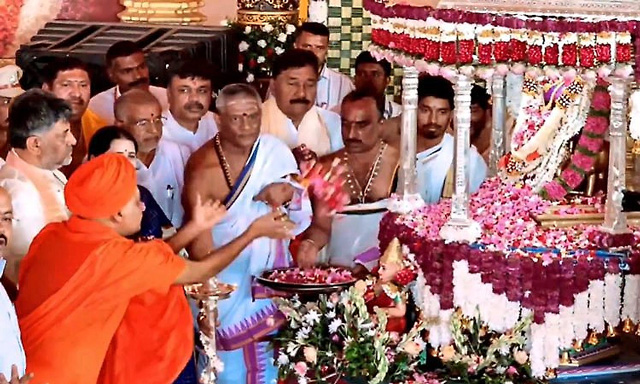
The goddess, revered as the Naada Devate (state deity) and worshipped as the guardian deity of Mysuru and its erstwhile royal family, was adorned in the Hamsavahini form.
Amid the chanting of Vedic hymns by priests, the seer and other dignitaries showered flowers on the beautifully decorated idol, formally ushering in the festivities. Earlier, the Swamiji, the chief minister and other dignitaries visited the Chamundeshwari Temple and offered prayers ahead of the inauguration.
Celebrated as Nada Habba (state festival), Mysuru Dasara, also known as Sharan Navaratri, is expected to showcase Karnataka’s rich cultural heritage, traditional art forms and royal legacy, drawing large crowds and tourists over the 11 days.
Mysuru set to dazzle with Deepalankaara, cultural extravaganza
Mysuru is preparing for a spectacular celebration, with palaces, major streets, traffic circles and prominent buildings being illuminated as part of the much-loved Deepalankaara tradition.
The festival calendar features a wide range of events catering to people of all ages and interests. These include a food mela, flower show, cultural programmes, Farmers’ Dasara, Women’s Dasara, Yuva Dasara, Children’s Dasara, poetry recitals and musical performances, among other attractions.
The traditional buffalo race of coastal Karnataka, Kambala, is also part of this year’s celebrations, adding another distinctive regional attraction to the festivities.
The iconic Jamboo Savaari, the grand Dasara procession, the Torch Light Parade and the Mysuru Dasara Exhibition are expected to draw large crowds. A special drone show featuring 3,500 LED drones is among the major attractions planned for this year.
Surya Kiran aerobatic team to enthral crowds
Adding an aerial spectacle to the celebrations, the Indian Air Force’s iconic Surya Kiran aerobatic team will present spectacular displays over Mysuru from October 18 to 20.
The Vijayadashami procession will also feature tableaux representing all three wings of the Indian Defence Forces, showcasing their valour, service and spirit as part of the grand finale of the festivities.
Beyond the public celebrations, Navaratri will be observed with traditional decorations and religious rituals in homes across Mysuru and neighbouring areas. Popular customs include Gombe Habba, the traditional arrangement of dolls, along with Saraswati Pooja, Ayudha Pooja and Durga Pooja.
Mysuru royal family to uphold age-old traditions
The Mysuru royal family will continue to observe Dasara according to its customary rituals within the palace.
Yaduveer Krishnadatta Chamaraja Wadiyar, scion of the erstwhile Mysuru royal family, will preside over the traditional Khasagi Durbar (private durbar), dressed in ceremonial attire and seated on the golden throne amid the chanting of Vedic hymns.
The royal observances remain an integral part of the festival’s historical legacy, reflecting traditions inherited from the rulers who once celebrated Dasara with great pomp and grandeur.
Golden howdah procession to mark Vijayadashami finale
The world-famous Jamboo Savaari will bring the celebrations to a grand conclusion on October 21, Vijayadashami.
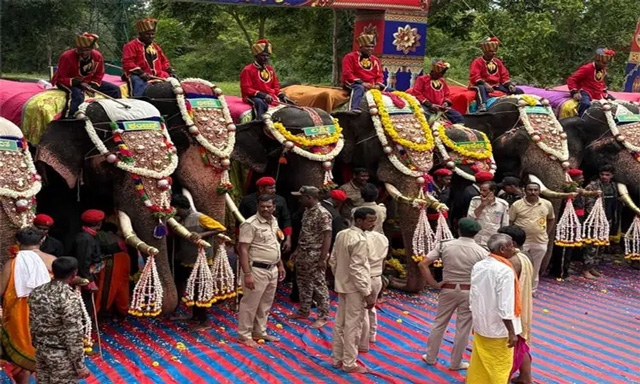
The procession’s principal attraction will be caparisoned elephants, including the elephant carrying the idol of Goddess Chamundeshwari in a gold-covered howdah. The spectacular procession remains one of the most recognisable symbols of Mysuru Dasara and a major draw for visitors from across India and abroad.
Dasara’s legacy stretches back over four centuries
The Dasara tradition was celebrated by the rulers of the Vijayanagar Empire before being inherited by the Wadiyars of Mysuru. The festivities were first formally celebrated in Mysuru by Raja Wadiyar I in 1610, establishing a tradition that has continued for more than four centuries.
Following the abolition of the privy purse in 1971 and the withdrawal of privileges enjoyed by the erstwhile rulers, Dasara became a private affair of the royal family. Local residents continued to organise low-key celebrations until the state government intervened.
In 1975, the then chief minister D Devaraja Urs revived the state-sponsored Dasara celebrations, a tradition that continues to this day, blending royal customs with public festivities and Karnataka’s cultural identity.
Elaborate security arrangements in place
Police have made extensive security and crowd-management arrangements to ensure that the celebrations proceed smoothly, officials said.
With religious rituals, royal traditions, cultural performances, sporting events, aerial displays and the grand Vijayadashami procession on the calendar, this year’s Mysuru Dasara is set to offer a spectacular showcase of Karnataka’s heritage and enduring traditions.