Pic: Niranjan M N
Daijiworld Media Network – Udupi
Udupi, Nov 1: The Karnataka government will discuss the introduction of a uniform policy for presenting district-level Karnataka Rajyotsava Awards across the state to ensure consistency, transparency and dignity in the selection process, said minister for food, civil supplies and consumer affairs and Udupi district in-charge minister Rizwan Arshad.
Speaking to reporters at Ajjarkad Grounds on November 1, on the sidelines of the 2026 Udupi district-level Karnataka Rajyotsava Awards ceremony, the minister pointed out that only two or three districts in the state currently presented district-level Rajyotsava Awards, while several others did not follow the practice.
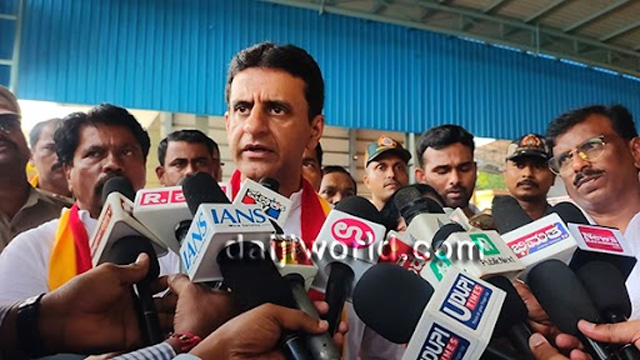
“The Kannada and Culture Department is discussing the formulation of a common policy for the state. We will discuss how the awards should be presented, the rules to be followed and the kind of committee to be constituted. Awardees should not be selected under political or other pressure. The awards must uphold their dignity and have a proper selection mechanism,” he said.
Minister to take up dropped awardee's case
Reacting to the controversy surrounding the removal of one name from the Udupi district Rajyotsava Award list after three names had initially been announced, Arshad said he would welcome a decision to honour all three nominees.
“I would be happy if all three received the honour. I am not aware of the exact reason why one name was subsequently removed. I will discuss the matter with Kannada and Culture Minister Shivaraj Thangadagi and make efforts in this regard,” he said.
Farmers' interests behind milk price hike
Responding to questions about the recent increase in milk prices in Karnataka, Arshad defended the government's decision, stating that it had been taken in response to demands from dairy farmers.
“Compared to Andhra Pradesh, Telangana and Tamil Nadu, milk prices in Karnataka were lower. Farmers were considering exporting milk to neighbouring states if prices were not increased. The government had to ensure that farmers did not suffer losses and that the state did not face a shortage of milk,” he explained.
However, he rejected suggestions that the price revision had been necessitated by the state's depleting financial resources or an emptying treasury.
Questions raised over SIR exercise
Commenting on the Special Intensive Revision (SIR) of electoral rolls, the minister accused the BJP-led Union government of weakening democratic institutions and alleged that the exercise was being used for political purposes.
“Governments may come and go, but the system in which people elect their representatives must continue. For democracy to survive, the Election Commission must function impartially. If it acts like an ally of the ruling party, it is our responsibility to protest,” he said.
Arshad recalled that Union Home Minister Amit Shah and several BJP leaders, including R Ashok and JD(S) leader H D Kumaraswamy, had earlier raised concerns over the alleged inclusion of Bangladeshi nationals in the country's electoral rolls and demanded a Special Intensive Revision.
“Now that the SIR exercise has been completed across the country, the government should disclose how many Bangladeshi and other foreign nationals were actually found in the electoral rolls,” he demanded.
771 people identified during exercise, claims minister
According to Arshad, 771 people were identified during the exercise. Of these, 588 were of Nepali origin and working in India to earn their livelihood, while 150 were Kannadigas who had acquired citizenship in other countries.
“Maintaining the sanctity of elections is important, but the exercise should not be used for political benefit, create confusion among people or manipulate the Election Commission. Such actions weaken democracy,” he alleged.
The minister further alleged that the SIR exercise was intended to exclude people from electoral rolls. He said the protest against the exercise would continue until justice was delivered.
The minister also criticised certain Bollywood actors, alleging that they were promoting communalism through their films and public messages directed at society.