Daijiworld Media Network - Panaji
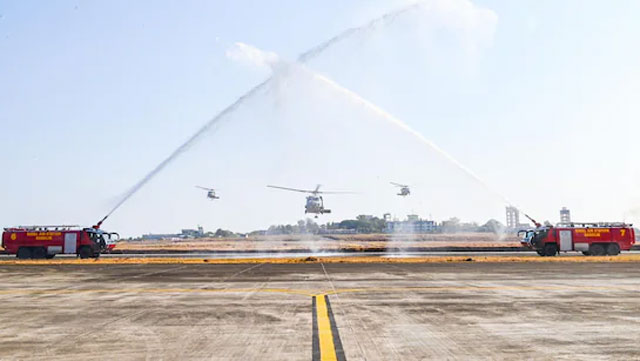
Panaji, Dec 18: The Indian Navy on Wednesday commissioned its second squadron of MH-60R (Romeo) anti-submarine helicopters — INAS 335 ‘Ospreys’ — at INS Hansa naval base in Goa, in a ceremony attended by Chief of Naval Staff Admiral Dinesh Tripathi. The event featured a traditional water cannon salute to mark the induction.
Speaking at the commissioning, Admiral Tripathi highlighted the importance of strengthening maritime security to safeguard India’s growing maritime interests. “The maritime environment today is more complex and contested than ever. Shifting geopolitics, fast-moving technologies, and an expanding spectrum of threats—from grey-zone activities to supply chain disruptions at sea—are shaping this new reality,” he said.
He added that India’s maritime journey towards becoming a Viksit Bharat by 2047 depends on enhancing maritime security and deterrence, particularly to protect sea lines of communication and national interests. The induction of the versatile, multi-role MH-60R helicopter on the Western Seaboard as part of the first operational squadron marks an important milestone for the Navy, he noted.
Admiral Tripathi recalled historical milestones, including 2025 marking 75 years since the Government of India approved the formation of a Fleet Air Arm, which gave wings to Naval Aviation, and the 64th anniversary of Operation Vijay on the night of 17–18 December 1961, when the Indian Navy played a crucial role in liberating Goa from Portuguese rule.
The Navy chief also spoke about future capabilities, highlighting the acquisition of 15 MQ-9B Sea Guardian RPAs to enhance persistent maritime surveillance and comprehensive Maritime Domain Awareness. He emphasized the Navy’s focus on both shore-based and shipborne aviation capabilities, including the recently signed contract for 26 Rafale-M carrier-borne aircraft, which will strengthen long-range maritime strike, land-attack capabilities, and fleet air defence.
“Complementing deck-based fighters, rotary-wing platforms, including shipborne uncrewed aviation systems, extend the Fleet’s ability to conduct persistent surface and air surveillance, standoff anti-submarine and anti-surface warfare, logistics support, and search-and-rescue at sea,” Admiral Tripathi said.
The commissioning ceremony was attended by Flag Officer Commanding-in-Chief Western Naval Command Vice Admiral Krishna Swaminathan, Chief of Staff Western Naval Command Rahul Vilas Gokhale, Assistant Chief of Naval Staff (Air) Janak Bevli, and Flag Officer Commanding Goa Area Rear Admiral Ajay D Theophilus. The event also witnessed a march past of the newly commissioned “flying destroyers.”