Daijiworld Media Network – New Delhi
New Delhi, Apr 30: Defence Minister Rajnath Singh on Thursday launched a sharp attack on Pakistan, accusing it of consistently supporting terrorism and emerging as an epicentre of “international terrorism.”
Speaking at the ANI National Security Summit 2.0 in New Delhi, Singh drew a comparison between India and Pakistan, noting that while India has earned global recognition in information technology, Pakistan has gained notoriety for backing terror activities.
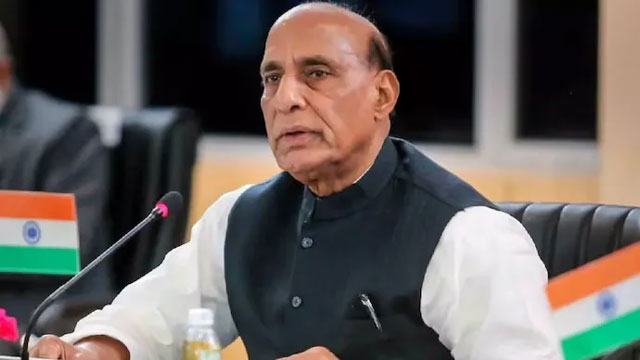
“While India is known worldwide for its Information Technology, Pakistan has come to be regarded as the epicentre of another ‘IT’ — International Terrorism,” he said.
Referring to Operation Sindoor, launched in response to the Pahalgam terror attack last year, Singh asserted that India halted the operation voluntarily and on its own terms, despite being fully prepared for a prolonged conflict if required.
“We didn’t stop the operation because our capabilities had diminished. We stopped it voluntarily, and if necessary, we were ready for a long war,” he said.
The Defence Minister highlighted that the Army, Navy and Air Force operated in a coordinated and integrated manner during the operation, reflecting the country’s enhanced military preparedness.
He also claimed that India had faced threats of a nuclear attack but did not succumb to what he described as a “bluff.”
Calling Operation Sindoor a symbol of a “new world order,” Singh said it marked a shift in India’s response to terrorism, moving beyond diplomatic measures to decisive action.
Taking another swipe at Pakistan, he said terrorism operates on three levels — operational, ideological and political — and stressed the need to dismantle the political support structures that enable such activities.
He added that attempts to justify terrorism on religious or ideological grounds effectively provide cover to terrorists.
Singh’s remarks come as the country approaches the first anniversary of Operation Sindoor, launched on May 7, 2025, which targeted multiple terror launchpads linked to groups such as Lashkar-e-Taiba, Jaish-e-Mohammed and Hizbul Mujahideen.
The operation had triggered a brief escalation between India and Pakistan, including drone attacks and cross-border shelling, before both sides agreed to a ceasefire on May 10.