Daijiworld Media Network – Washington
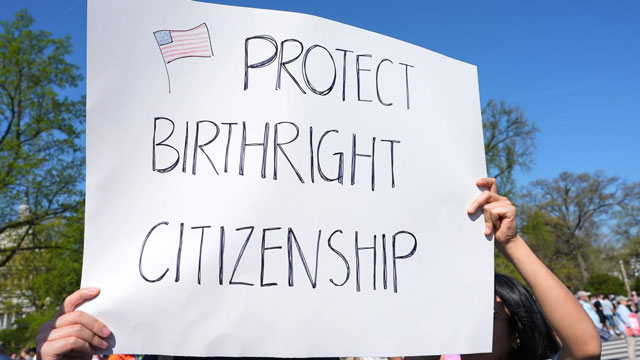
Washington, Jun 18: A pending US Supreme Court decision on birthright citizenship has triggered growing concern among immigrant families and civil rights advocates, who fear it could pave the way for restricting automatic citizenship for children born in the United States to undocumented immigrants.
The case centres on President Donald Trump's executive order issued in January 2025 seeking to end birthright citizenship for newborns whose parents entered or remained in the country without legal authorisation. The move challenges the long-standing interpretation of the 14th Amendment, which has traditionally guaranteed citizenship to nearly everyone born on US soil.
Among those anxiously awaiting the court's ruling is Ana Temu Otting, a Colorado-based business owner born in Los Angeles to parents who lacked legal immigration status when she was born. Although both she and her husband were US citizens when their five-year-old son David was born, she fears that any rollback of birthright citizenship could have far-reaching consequences for future generations.
“It feels like all bets are off the table for anyone at this point,” Temu Otting said, expressing concern over what she sees as unprecedented challenges to established citizenship rights.
Legal advocates argue that the case has unsettled what many Americans considered a constitutional certainty. Noah Baron, assistant director of litigation at the Asian Americans Advancing Justice (AAAJ), which is challenging the executive order, said millions of people now fear that fundamental rights may no longer be secure.
Birthright citizenship in the United States is rooted in the 14th Amendment, adopted in 1866 following the Civil War to ensure citizenship rights for formerly enslaved people and their descendants. In the landmark 1898 case involving Wong Kim Ark, the Supreme Court ruled that a child born in San Francisco to Chinese parents was a US citizen, establishing the modern interpretation of the amendment.
The phrase “subject to the jurisdiction thereof” has historically been applied only to limited exceptions, such as children born to foreign diplomats or occupying military forces.
If the Supreme Court allows Trump's order to take effect, it could affect an estimated 255,000 babies born annually in the United States, according to various analyses. Critics argue that such children could effectively become stateless if they do not automatically acquire citizenship elsewhere.
Supporters of the policy contend that birthright citizenship has been exploited through practices such as “birth tourism,” where foreign nationals travel to the US specifically to give birth and secure citizenship for their children.
Several Republican lawmakers, including Senator Ted Cruz, have supported the administration's position, arguing that unrestricted birthright citizenship could create national security concerns and weaken congressional authority over immigration policy.
According to estimates cited in the legal debate, approximately 14 million undocumented immigrants currently reside in the United States, while another 5.5 to 6.5 million people hold temporary or provisional immigration status, including asylum seekers, recipients of humanitarian protections and participants in deferred-action programmes.
Immigrant rights advocates warn that any weakening of birthright citizenship could create uncertainty for millions of families with mixed immigration status and potentially open the door to broader challenges against citizenship rights in the future.
While legal experts note that the current case focuses on newborns rather than existing citizens, concerns persist among affected communities about the long-term implications of a Supreme Court ruling in favour of the administration.
For families such as the Temu Ottings, the case has become a deeply personal issue tied to their sense of identity and belonging. Ana said her family came to the United States seeking opportunity, safety and freedom, values she believes are now being tested by the ongoing legal battle.
The Supreme Court's ruling, expected in the coming weeks, could have significant implications for immigration policy, constitutional law and the future interpretation of American citizenship.