Daijiworld Media Network - United Nations
United Nations, Jun 22: United Nations Secretary-General Antonio Guterres has called for renewed political commitment and international cooperation to accelerate efforts to end AIDS as a global public health threat by 2030.
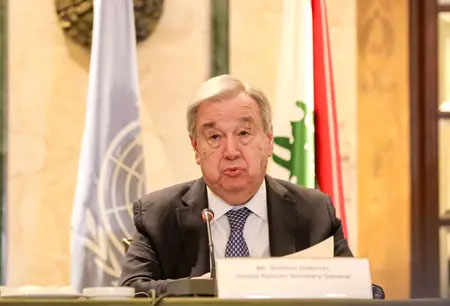
Speaking through Deputy Secretary-General Amina Mohammed at the opening plenary of the UN General Assembly's High-Level Meeting on HIV/AIDS on Tuesday, Guterres said the world must once again unite to sustain momentum in the fight against HIV.
"This meeting is an opportunity to find solutions and renew the political will needed to accelerate and complete the global fight against HIV," his statement said.
Reflecting on the progress achieved over the past four and a half decades since the first AIDS case was reported, Guterres said the international community had demonstrated extraordinary solidarity and determination despite numerous challenges.
He highlighted that strong political commitment from governments and sustained investments from global partners have significantly reduced AIDS-related deaths worldwide. Fatalities have fallen by 70 per cent since their peak in 2004 and by 54 per cent since 2010.
The UN chief also noted that expanded prevention and treatment services have helped reduce new HIV infections by 40 per cent since 2010. More than 32 million people living with HIV are currently receiving life-saving antiretroviral treatment.
However, he cautioned that the fight is far from over.
"AIDS is not over," Guterres said, pointing out that an estimated 9.2 million people still lacked access to HIV treatment at the end of 2024.
To accelerate progress, he outlined five key priorities for the global community:
Closing persistent gaps in access to HIV prevention, treatment and care services.
Strengthening the leadership role of communities in the HIV response.
Protecting human rights and combating discrimination.
Securing sustainable financing for HIV programmes.
Revitalising multilateral cooperation that has underpinned global progress for decades.
Guterres said the global HIV response has proven that collective action can overcome inequality, fear and injustice.
"The HIV response has shown that solidarity across borders and sectors can overcome fear, inequality and injustice. It has also demonstrated that global, regional and local institutions are all essential to delivering results together," he said.
Describing the high-level meeting as an opportunity to reaffirm the world's commitment to science, human dignity and shared responsibility, the UN chief stressed that ending AIDS by 2030 is a responsibility shared by every nation and every individual.
He concluded by urging governments, institutions and communities worldwide to work together to ensure that the goal of eliminating AIDS as a public health threat becomes a reality within this decade.