Daijiworld Media Network – New Delhi
New Delhi, Jul 13: The Supreme Court on Monday stayed a Madras High Court order directing the Tamil Nadu government to ensure that no cow or calf is slaughtered in the state on the eve of Bakrid or on any other day.
A bench comprising Justice Vikram Nath and Justice Sandeep Mehta issued notice to the respondents after the Tamil Nadu government challenged the High Court's directions.
The apex court observed that the High Court's order required "correction" and stayed its operation with immediate effect. The directions will remain stayed until further orders.
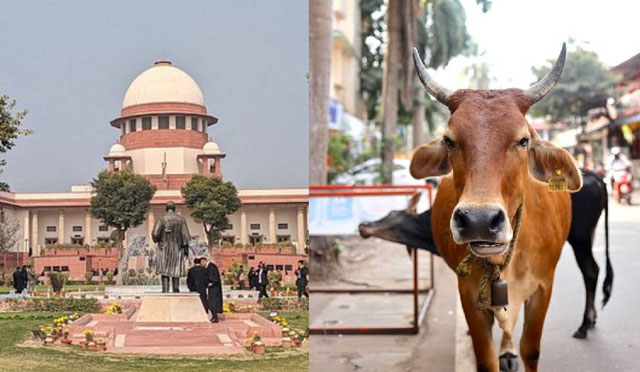
The Tamil Nadu government had approached the Supreme Court nearly two weeks ago, contending that the High Court had imposed a blanket ban on cow slaughter beyond the provisions of the Tamil Nadu Animal Preservation Act, 1958.
The state argued that the order was contrary to the 1958 Act, which permits the slaughter of cattle under specific conditions, including when an animal is over 10 years old or is no longer fit for breeding or agricultural work, subject to certification by the competent authority.
The dispute stems from a May 27 order passed by a division bench of the Madras High Court comprising Justice G R Swaminathan and Justice V Lakshminarayan.
While observing that animal slaughter could be carried out only in authorised slaughterhouses, the High Court had directed the Chief Secretary and senior police officials to ensure that no cow or calf was slaughtered on Bakrid "or on any other day". It had also instructed the authorities to issue directions across the state to enforce the order.
In its plea before the Supreme Court, the Tamil Nadu government argued that the High Court's directions were internally contradictory. It said that while the court recognised that slaughter could take place in authorised slaughterhouses, it simultaneously imposed a complete prohibition on cow slaughter, exceeding the legal framework prescribed under the Act.
The state maintained that the High Court had gone beyond its jurisdiction by issuing a blanket ban not contemplated under the law.
The case originated from a petition filed by Surya, state general secretary of the Indu Makkal Katchi, seeking directions to prevent the alleged illegal slaughter of cows in public places. The petitioner claimed he had submitted a representation to the authorities, but no action had been taken.
While hearing the petition, the High Court referred to Article 48 of the Constitution, a Directive Principle of State Policy, which directs the state to take steps to prohibit the slaughter of cows, calves and other milch and draught cattle.
The High Court also noted that Section 4 of the Tamil Nadu Animal Preservation Act permits cow slaughter only if the animal is over 10 years old, is unfit for breeding or agricultural work, and has been certified as such by the competent authority. It held that the provision must be interpreted strictly in the light of Article 48 and that the certification requirement could not be bypassed.
The High Court had further relied on a government order stating that restrictions on cow slaughter were necessary to improve milk production and support the rural economy. However, the state government has argued that the blanket prohibition directed by the High Court goes beyond the scope of the Act.