Daijiworld Media Network - Washington
Washington, Aug 8: US Republican Congressman Riley Moore’s criticism of the proposed amendments to India’s Foreign Contribution Regulation Act (FCRA), claiming that the changes could give the Indian government greater control over churches and Christian organisations and adversely affect India-US relations, amounts to little more than propaganda, a report has said.
According to a report published by the European Times, Moore’s intervention ironically strengthens the very rationale behind the FCRA. It said that when lawmakers from another country publicly intervene in laws governing foreign funding in India, it reinforces New Delhi’s argument that external influence over domestic institutions is “neither hypothetical nor obsolete”.
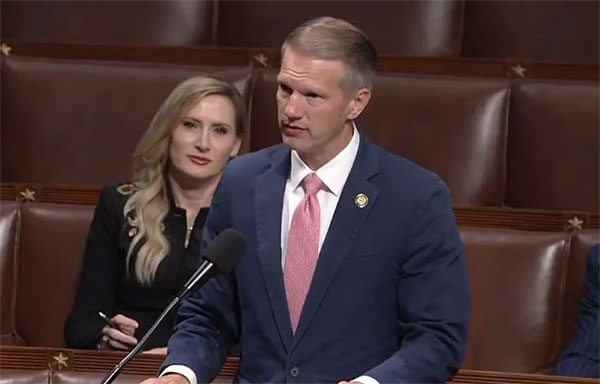
“As the Indian Parliament prepares once again to debate the Foreign Contribution Regulation Act (FCRA), a familiar narrative has re-emerged,” the report said.
Critics have portrayed the legislation as an attack on civil society, Christian organisations and India’s democratic norms. However, the report questioned why India should be denied the sovereign right to regulate foreign influence when several major democracies are moving in the same direction.
The report said India’s FCRA and its proposed amendments are not unique, but form part of a broader global trend aimed at regulating foreign influence and funding.
It pointed out that the European Union is developing new mechanisms to counter foreign interference and covert influence operations, particularly those attributed to Russia, China and other foreign actors.
Similarly, Australia has its Foreign Influence Transparency Scheme, while the United States has enforced the Foreign Agents Registration Act (FARA) for decades. The United Kingdom, meanwhile, has introduced its own Foreign Influence Registration Scheme.
The report said the underlying principle of these frameworks is similar: foreign funding should not be allowed to influence a country’s political, social or institutional landscape without adequate transparency and oversight.
The Indian government has maintained that the proposed FCRA amendments are in line with international best practices and are not intended to create an exceptional regulatory regime.
The report also highlighted the scale of India’s civil society sector, noting that the country faces a challenge of a vastly different magnitude compared to other nations.
India is estimated to have between 3.3 million and 3.7 million non-governmental organisations (NGOs), making it by far the largest civil society sector among G20 nations and accounting for more than half of all NGOs across the grouping.
Even conservative estimates, the report said, show that no other G20 member comes remotely close to India’s scale. Italy, for instance, has approximately 360,000 third-sector organisations, according to the European Times.
“India therefore administers by far the largest NGO ecosystem on the planet,” the report said, adding that regulating foreign funding in an ecosystem of such magnitude is “not merely a bureaucratic exercise or a political choice” but a matter of national security.