Daijiworld Media Network - New Delhi
New Delhi, Oct 6: The fight against narcotics smuggling remains an ongoing challenge for Indian agencies, with new threats emerging with each passing day. While drug cartels operating from Pakistan have come under sustained pressure amid the Centre’s efforts to make India drug-free, agencies continue to face a major challenge from networks operating through the northeastern states.
Officials said that despite significant success in dismantling networks linked to operators such as Dawood Ibrahim and Haji Salim, the porous borders and difficult terrain of the Northeast continue to provide opportunities for drug traffickers and their networks.
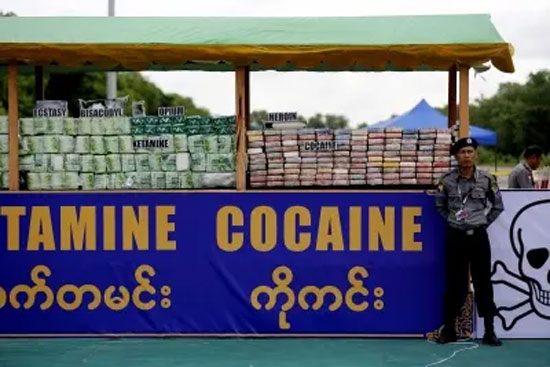
An official said India’s border with Myanmar remains the biggest challenge. The ban on opium cultivation in Afghanistan under the Taliban regime has opened greater opportunities for cartels operating in Myanmar.
“Today Myanmar reportedly produces the largest quantity of opium in the world. Statistics show that in the year 2025, the cultivation area of opium rose to 53,100 hectares,” the official said.
Indian agencies, including the Narcotics Control Bureau (NCB) and Assam Rifles, continue to work closely, leading to major drug seizures over the past two to three years.
However, large quantities of narcotics continue to enter India. The cultivation of opium in Myanmar remains a challenge beyond India’s direct control. India and Myanmar have held several rounds of talks on the issue and agreed to work together to combat the menace.
Officials said tackling the problem would take time given the enormous scale of operations run by drug cartels in Myanmar.
Another official said Myanmar’s drug cartels are vast and have access to enormous financial resources.
“There is a strong possibility that the combined wealth of these cartels could be significantly greater than that of a government,” the official said.
This financial strength adds to the challenge faced by Indian agencies. Even when multiple consignments linked to these cartels are intercepted, the networks can quickly regroup and establish fresh supply chains, officials said. Their financial resources enable them to absorb losses and continue their operations.
An Intelligence Bureau official said the cartels have repeatedly sought to exploit conflicts and unrest in the northeastern states, particularly Manipur.
According to the official, such situations provide drug networks with opportunities to expand their operations and strengthen their presence in the region.
Investigations on several occasions have revealed that the cartels allegedly hired their cronies in the states to deliberately rake up sensitive issues and trigger violence. Such violence can continue for several days or even months, the official said.
This keeps security agencies focused on containing the violence, allowing the cartels to take advantage of the situation and move large consignments into the Northeast, the official added.
In 2025, the NCB had described the scale of the narcotics trade emerging from Myanmar as “dramatic”. In March 2026, the government informed the Lok Sabha that the number of seizures had increased considerably.
In Assam and Tripura, seizures stood at 31,706 kg and 46,346 kg respectively. In Mizoram, seizures increased from 1,967 kg in 2024 to 2,233 kg in 2025.
The state also witnessed a major spike in another set of seizure figures, with 284 kg of narcotics seized in 2024 compared with 2,556 kg in 2025.
Officials said the seizures were undoubtedly significant, but the problem persisted. Intelligence reports indicated that cartels had ramped up production in 2026 by nearly three times, adding to the challenge faced by agencies because of the sheer volume of drugs being produced.
While Myanmar’s drug cartels have contributed to the country emerging as one of the world’s largest sources of illicit opium, they are also producing synthetic drugs on a large scale.
The growing flow of synthetic drugs from Myanmar into Indian markets poses another major challenge for enforcement agencies. Methamphetamine, in particular, is being smuggled into India in large quantities, driven by strong demand in the domestic market.
Indian agencies are not only battling the scale of drug production and smuggling but also the difficult terrain in which they have to operate.
The Moreh-Tamu border is a key transit point for narcotics cartels. Adding to the challenge are porous stretches along the India-Myanmar border, as well as forested and hilly terrain, which makes operations extremely difficult for Indian agencies, an official said.