Daijiworld Media Network – New Delhi
New Delhi, Jun 11: Pakistan has significantly expanded its space-based surveillance capabilities through a series of Chinese-backed satellite launches, while India's indigenous navigation system, NavIC, is facing one of its most challenging phases since its inception.
Over the past 16 months, Pakistan has launched six Earth-observation satellites, creating an increasingly sophisticated surveillance network capable of monitoring developments across Indian territory with greater frequency and precision. The rapid expansion, undertaken largely with Chinese assistance, marks a major shift for Pakistan's traditionally limited space programme.
Analysts note that the satellite buildup began even before the Pahalgam terror attack and India's subsequent Operation Sindoor, indicating a broader long-term strategy to strengthen Islamabad's space-based intelligence and reconnaissance capabilities.
Experts say the significance of the new satellite constellation lies not only in the number of satellites but also in their combined operational capabilities. The network can capture high-resolution imagery, monitor ground movements, identify concealed objects and maintain persistent surveillance over strategically important locations.
According to Rear Admiral Sudhir Pillai, the constellation appears to have clear military and security applications.
“The constellation that has emerged from this sixteen-month burst is not a civilian earth observation system that happens to have military applications on the side,” he observed in an analysis of Pakistan's recent launches.
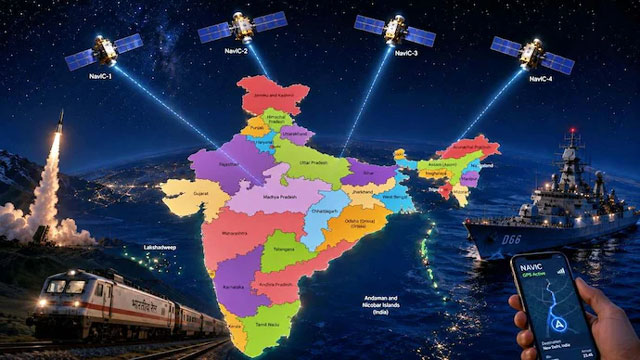
The development comes at a time when the Indian Space Research Organisation is grappling with challenges affecting the Navigation with Indian Constellation (NavIC), India's indigenous satellite navigation system.
Developed as India's answer to the American GPS network, NavIC was conceived after the Kargil conflict highlighted the risks of dependence on foreign navigation systems during military operations.
The system provides Positioning, Navigation and Timing (PNT) services across India and extends coverage up to 1,500 km beyond its borders, including large parts of the Indian Ocean Region. It supports both civilian users and secure military operations.
However, several first-generation NavIC satellites launched between 2013 and 2016 are nearing or have exceeded their intended operational lifespan.
A number of these satellites have suffered failures in their rubidium atomic clocks, which are essential for maintaining precise timing and navigation accuracy. Once these clocks fail, the satellites can no longer provide reliable positioning services.
The situation became more challenging after the second-generation replacement satellite NVS-02 experienced propulsion-related issues and failed to reach its intended operational orbit, disrupting ISRO's plans to strengthen the constellation.
Industry assessments indicate that only a limited number of satellites, including IRNSS-1B, IRNSS-1I and NVS-01, are currently capable of delivering full navigation services. While some experts count an additional partially functional satellite, the constellation remains well below its planned strength of seven operational satellites.
A robust regional navigation system ideally requires at least seven satellites, while a minimum of four is generally necessary for reliable three-dimensional positioning coverage.
Despite the setbacks, ISRO continues work on strengthening the network through additional second-generation NavIC satellites. The upgraded constellation will introduce L1-band signals alongside the existing L5 and S-band frequencies, improving compatibility with smartphones and expanding civilian usage.
For India, NavIC remains strategically important beyond navigation alone. The system supports missile guidance, naval operations, secure military communications, disaster management, fleet tracking and the synchronisation of critical infrastructure.
As Pakistan rapidly enhances its space-based surveillance capabilities, India faces increasing pressure to restore and strengthen its sovereign navigation network. The growing competition highlights how strategic rivalry in South Asia is increasingly extending into space, where satellites play a vital role in defence, intelligence and national security.