Daijiworld Media Network - Washington
Washington, Aug 3: The US Department of State on Sunday raised its travel advisory for Ceuta, Spain's North African enclave, to Level 3, urging American citizens to reconsider travel following a massive influx of migrants from Morocco that triggered security concerns.
The advisory came nearly two days after around 60,000 migrants entered Ceuta by crossing maritime boundaries and scaling border fences in one of the largest recent breaches along the frontier.
In its updated advisory, the State Department warned that the "massive and uncontrolled arrival of migrants from Morocco to Ceuta may lead to unpredictable and dangerous security situations."
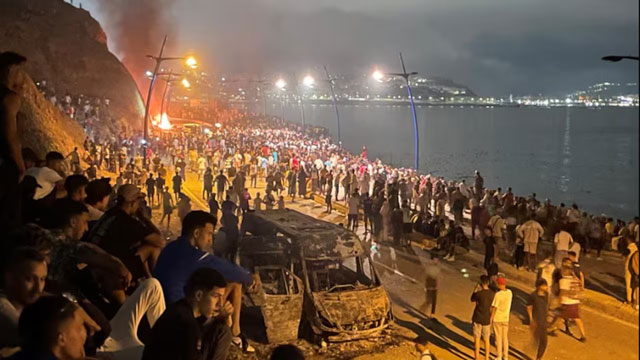
It noted that Spain had deployed the military, the Spanish National Police and the Guardia Civil to respond to the situation.
The Level 3 advisory applies only to Ceuta, which borders Morocco. Travel guidance for mainland Spain and the country's other territories remains unchanged.
The warning was issued as US Assistant Secretary of State Dylan Johnson criticised Spain's centre-left coalition government, accusing it of failing to adequately secure the country's borders.
Speaking to Fox News Digital, Johnson said, "This invasion is the direct result of the Spanish government's refusal to secure its borders and defend its people, and now threatens the security of Europe."
According to reports, many of the migrants coordinated their journey through social media platforms and had spent weeks preparing for the crossing. Accounts published by The New York Times and the Financial Times indicated that dwindling job opportunities in Morocco and uncertainty over legal protections following a recent Spanish Supreme Court ruling encouraged many to attempt the journey.
Media reports also suggested that Moroccan border forces made limited efforts to prevent people from moving towards the Ceuta border.
The mass crossing reportedly resulted in dozens of migrant deaths, while thousands of others were either detained or returned by Spanish authorities.
Responding to the crisis, Spanish Prime Minister Pedro Sanchez announced measures to reinforce security in Ceuta, including deploying additional border personnel, constructing a physical maritime barrier to facilitate deportations and continuing cooperation with Moroccan authorities to dismantle human smuggling networks.
The unprecedented influx has placed severe strain on Ceuta's infrastructure and reignited debate across Europe over migration policy, an issue that continues to shape the political landscape in several countries.