Daijiworld Media Network – Bengaluru
Bengaluru, Sep 10: Student politics is set to return to Karnataka’s colleges and universities from the 2026-27 academic year, with the State Cabinet giving its nod to the resumption of student union elections while putting a bar on campaigning by political parties and organisations.
The decision was among several major resolutions taken at the Cabinet meeting chaired by chief minister D K Shivakumar at Vidhana Soudha in Bengaluru.
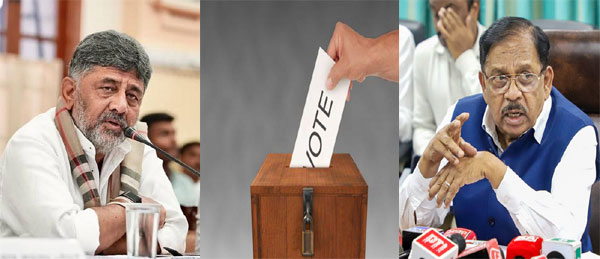
Deputy chief minister Dr G Parameshwara, who briefed reporters after the meeting, said the decisions covered student elections, employment generation, healthcare infrastructure, aerospace and defence manufacturing, housing for the poor and the Shakti scheme.
The Cabinet has approved the reintroduction of student union elections in colleges and universities across Karnataka from the 2026-27 academic year.
The move is aimed at fostering leadership, responsibility and democratic values among students.
Student elections were previously held in colleges but were later banned for various reasons. The government has now decided to bring them back.
“Student elections used to be held in colleges earlier, but they were banned for certain reasons. We have now decided to conduct the elections again,” Parameshwara said.
However, political parties and organisations will not be allowed to enter campuses and campaign during the elections, he added.
In a push to generate jobs, the Cabinet has decided to promote employment creation in 10 districts under the Employment Fund scheme.
Employers creating jobs will receive an incentive of Rs 2,500 per employee every month for two years.
The measure is intended to encourage the creation of new employment opportunities and boost economic activity in the selected districts.
The Cabinet has approved the construction of 182 Tele-ICUs at a cost of Rs 10 crore.
It has also cleared Phase-I of the Karnataka Digital Radiography Mission, under which 162 X-ray units will be upgraded to digital systems.
The digital upgrade will involve an expenditure of Rs 40.50 crore, Parameshwara said.
The Cabinet has approved the Karnataka Aerospace Policy 2026-31, with the State setting its sights on making Karnataka a major hub for aerospace, defence and aviation manufacturing and innovation.
The policy targets Rs 60,000 crore in investment over five years and seeks to generate 60,000 jobs.
The policy divides locations into focus areas and non-focus areas, with subsidies and other incentives proposed to attract investors.
Parameshwara said there was also a plan involving the production of 40 aircraft at Hindustan Aeronautics Limited (HAL).
“We have included provisions in the policy to provide subsidy-based support to manufacturers who come forward for projects of this nature,” the deputy chief minister said.
The State Government has also decided to establish a Drone Technology Facility Centre in Chikkaballapura at a cost of Rs 42.83 crore.
The facility is part of the government’s efforts to strengthen drone technology and innovation in the State.
In another major decision, the Cabinet has approved the distribution of 15 lac residential sites to poor people across Karnataka.
The government has decided to allocate 50,000 sites to each district, with the distribution to be carried out in three phases.
The first phase will see five lakh sites distributed in September, followed by another five lac sites in the second phase and five lac in the third phase.
This will take the total number of sites to be distributed across the State to 15 lac.
The Cabinet has also approved the introduction of smart cards under the Shakti scheme, which provides free bus travel to women.
The smart-card initiative is expected to cost Rs 237 crore, with the State Government contributing Rs 100 crore.
The cards will be distributed through a public-private partnership (PPP) model.
Parameshwara said the system would help the government obtain accurate data on women’s free travel under the Shakti scheme.
The Cabinet decisions collectively cover employment generation, student participation in democratic processes, healthcare infrastructure, high-tech manufacturing, housing support and improved monitoring of one of Karnataka’s key welfare schemes.