Daijiworld Media Network - New Delhi
New Delhi, Oct 27: India has asserted that any reform of the United Nations Security Council that creates a new category of permanent members without veto powers would relegate them to “second-class” status, leaving the existing five permanent members in control of decision-making.
Addressing the Inter-Governmental Negotiations (IGN) plenary on the question of the veto at the UN General Assembly on Monday, India's Permanent Representative to the UN, Ambassador Harish Parvathaneni, said all permanent members of a reformed Security Council must have veto powers as long as the provision continues to exist.
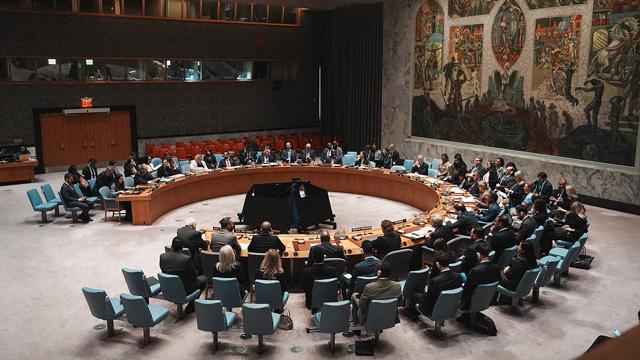
China, France, Russia, the United Kingdom and the United States are the five permanent members of the 15-member Security Council and enjoy veto powers. The remaining 10 members are elected for two-year terms.
Parvathaneni said creating another category of long-term members without veto powers would not alter the decision-making dynamics of the existing five permanent members, commonly known as the P5. He added that creating a new category of permanent members, with or without veto powers, would complicate negotiations and deepen the inequalities that reform efforts seek to address.
“Periodic elections and the concept of permanency are fundamentally contradictory,” the diplomat said.
Recalling the only expansion of the Security Council in 1965, Parvathaneni said the number of non-permanent members had increased from six to 10 while the five permanent members retained their positions. This changed the ratio of permanent to elected members from 5:6 to 5:10, further strengthening the relative power of the P5, he said.
India has consistently called for expanding both permanent and non-permanent membership categories, warning that efforts focused only on increasing the number of non-permanent members would fall short of meaningful reform.
New Delhi has been advocating Security Council reform for years, arguing that the body, established in 1945, no longer reflects contemporary geopolitical realities. India has maintained that it deserves a permanent seat on the Council.
India is also seeking a non-permanent seat for the 2028-29 term. Elections are scheduled for June next year, when India and Tajikistan will contest the sole seat allocated to the Asia-Pacific Group. India last served on the Council in 2021-22, its eighth term, having previously held seats in 1950-51, 1967-68, 1972-73, 1977-78, 1984-85, 1991-92 and 2011-12.
Parvathaneni also stressed that the veto, currently held by the five permanent members, should be exercised with “great restraint”, particularly on matters concerning international peace and security. He said it should not be used as an instrument of narrow political expediency.
He added that discussions on limiting the veto could not be separated from other aspects of Security Council reform, including membership categories, regional representation, the Council's size and its working methods.
India called for a comprehensive approach to reform, with text-based negotiations beginning at the earliest and proceeding according to clearly defined timelines and milestones.
Parvathaneni further pointed out that the use of veto-like powers extended beyond formal votes by permanent members. According to him, any Security Council member could effectively block presidential statements, press statements and decisions of sanctions committees, where the unwritten rule of consensus allows a single member to obstruct a proposal, often without explanation.
He was referring to the functioning of UNSC sanctions committees, which designate and delist terror outfits and individuals.
The diplomat also criticised the use of consensus as a “disguised, de facto veto” within the Intergovernmental Negotiations process itself. Referring to the UN General Assembly resolution that established the framework for negotiations, he said the guiding principle was the widest possible political acceptance rather than consensus.
“Seventeen cycles later, we have no outcome to show for it,” he said.
India maintained that the Council's credibility, legitimacy and effectiveness could not be restored by addressing the veto alone. Parvathaneni said its structure must reflect present-day realities rather than the outcome of a war fought eight decades ago.