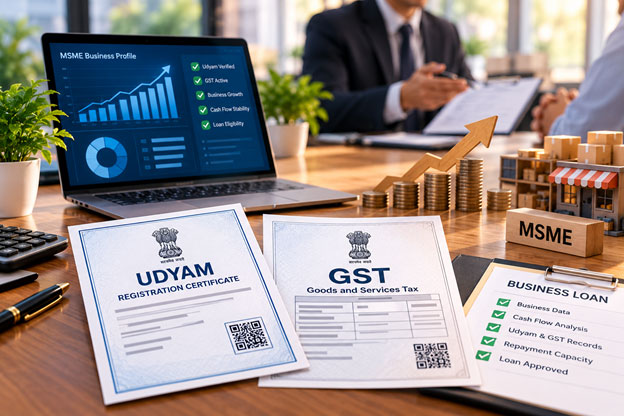
Small businesses across India are finding new ways to access funding as lenders increasingly use business data to assess loan applications. Udyam registration and Goods and Services Tax (GST) records help lenders understand the identity, sales activity and financial position of a business. For businesses with steady sales but limited physical assets, these records can demonstrate business activity and support loan applications.
While collateral remains a requirement for some loans, reliable business records give lenders another way to assess the repayment capacity of a borrower.
What Are Udyam Registration and GST Records?
The MSME full form stands for Micro, Small and Medium Enterprises. These businesses play an important role in the Indian economy and can register under the Udyam system of the government.
Two types of records can help lenders assess an MSME:
- Udyam registration: This is the official MSME registration by the Government of India. It records key business details and its MSME category. Businesses can register for free through the official Udyam Registration portal (https://udyamregistration.gov.in/).
- GST records: These include tax returns and sales information reported by businesses registered under GST. Regular, accurate filings help lenders understand sales activity and check whether the reported figures are consistent.
Together, these records can give lenders a clearer picture of a business. They do not guarantee loan approval, but they can support the assessment of an application.
Why Lenders Look Beyond Collateral
Collateral gives a lender an asset it may recover if a borrower fails to repay a loan. However, owning property does not always show whether a business earns enough to manage its monthly payments.
Business records provide another way to assess an applicant. Udyam registration helps establish the identity of the business, while GST filings can provide information on reported sales. Lenders may also review bank statements, existing loan payments, credit history and other financial details.
The table below shows the difference between the two approaches.
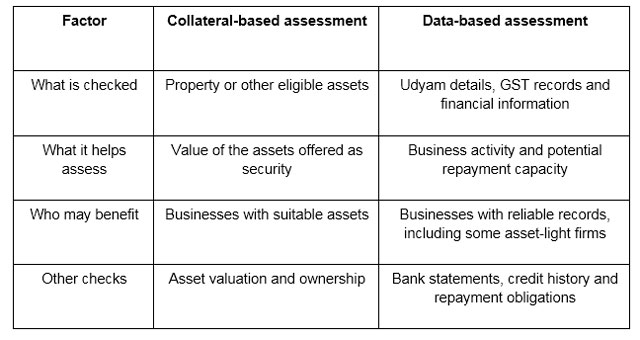
Neither approach guarantees approval. The policy of the lender, the loan amount, the repayment capacity of the borrower and the type of loan all influence the final decision. However, reliable business records can help an MSME demonstrate its financial activity even when it has limited assets to pledge.
How Better Business Records Can Help Small Businesses
For businesses that rely on sales rather than property, accurate records can simplify the loan application process. These records may help in several ways:
- Support the loan application: Udyam and GST details can help establish the identity of the business and reported activity.
- Make verification easier: With the required consent, lenders may be able to check relevant information through authorised digital processes.
- Help first-time borrowers: Businesses with limited borrowing history can use financial and tax records to demonstrate activity, although lenders will still consider other eligibility requirements.
- Improve financial visibility: Regular records can help business owners understand sales patterns and plan repayments.
- Support suitable funding choices: Lenders can use available financial information, along with other checks, to assess the loan amount and terms an applicant may qualify for.
For MSMEs exploring funding options, leading lending institutions like Godrej Finance Limited offer Business Loans for MSMEs. Business owners should review the eligibility criteria, applicable charges and repayment terms before applying. Approval depends on the assessment of the lender and the applicant meeting the relevant requirements.
How to Keep Your Business Records Ready for a Loan
Accurate, up-to-date records can help a lender review an application. Business owners can take the following steps before applying for an MSME Loan.
- Register or update Udyam details: Check that the business information is correct. If the business is not registered, use the official Udyam Registration portal (https://udyamregistration.gov.in/). Registration is free, so avoid unofficial websites that charge a fee for the registration itself.
- File GST returns on time: Keep applicable returns up to date through the official GST portal (https://www.gst.gov.in/).
- Check that figures match: Review GST filings, invoices, sales records and bank statements for errors or unexplained differences.
- Maintain clear transaction records: Use a separate business bank account where possible and keep invoices and payment details organised.
- Review cash flow: Track regular income, operating costs, existing loan payments and seasonal changes in sales.
Before applying, estimate how much the business can afford to repay each month. A Business Loan EMI Calculator helps you estimate monthly instalments by entering the loan amount, interest rate and repayment tenure. Then compare the estimated EMI with the regular cash flow of the business before deciding how much to borrow.
What Should MSME Borrowers Keep in Mind?
Good records can strengthen a loan application, but they do not replace the need to assess affordability. Keep these points in mind:
- Report accurate information: Do not change figures to make the business appear stronger. Differences between reported sales and actual transactions may raise questions during verification.
- Look at sales over time: One strong month may not reflect the usual income of the business. Consider seasonal changes and recurring expenses before deciding on a loan amount.
- Check the total borrowing cost: Review the interest rate, processing fees, repayment schedule and other applicable charges. A quick decision is useful only if the loan also suits the finances of the borrower.
- Understand the requirements of the lender: Some loans require collateral, while others are available without it. Confirm the eligibility criteria and documents needed before applying.
Final Thoughts
Udyam registration and GST records can help lenders understand the business activity of an MSME and assess its loan application. For businesses with steady sales but limited physical assets, reliable records can provide useful evidence of their operations and financial position. Business owners should keep their registration details accurate, file applicable GST returns on time and review their cash flow before borrowing. Although some loans may still require collateral, good records can help businesses prepare stronger applications and make better-informed funding decisions.