
Most people who apply to essay writing platforms think the bar is low. They can write well, they know grammar, they have a degree. That should be enough. It usually is not. The writers who actually stick around and build something sustainable from this work tend to have a specific combination of skills that goes well beyond typing clean sentences. Understanding what those skills are, and whether you genuinely have them, is the real starting point for anyone thinking about this kind of work.
It Starts With the Writing, But Not the Way People Expect
Strong academic writing is not the same as being a good writer in the general sense. A person can be a talented blogger or storyteller and still struggle badly with the structural demands of a 3,000 word argumentative essay. Academic writing follows patterns. It requires a working knowledge of argument construction, source integration, thesis development, and the ability to write in a register that sounds educated without sounding robotic.
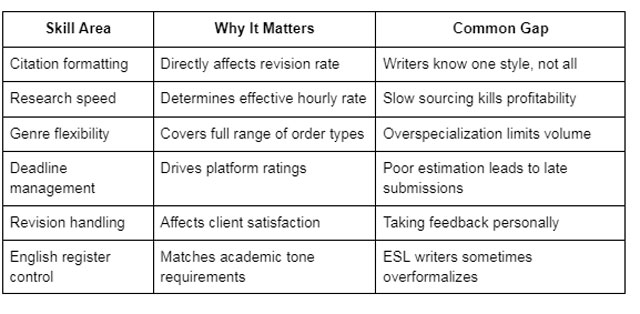
One area that separates average applicants from strong ones is comfort with genre diversity. A writer who can only handle straightforward five paragraph essays will hit walls fast. Platforms receive orders across the full academic spectrum. Knowing how to approach reflective essay writing, for instance, requires a completely different mental frame than a literature review or a policy analysis. The skill is not just writing. It is switching modes on demand.
Citation fluency matters more than most newcomers expect. APA, MLA, Chicago, Harvard, Turabian. These are not interchangeable, and clients notice when they are mixed up or applied incorrectly. Writers who treat citation as an afterthought tend to generate revision requests, which eats into their effective hourly rate fast.
Research Is Half the Job
Essay writing service jobs are fundamentally research jobs that happen to produce written output. A writer who cannot locate credible sources, evaluate them quickly, and pull out relevant information will spend far too long on each order to make the work financially viable.
This is part of why so many students themselves decide to pay someone to do your research paper when deadlines close in. The research phase alone can take hours, and if a writer is slow at it, that problem compounds across every single order.
The research skills that matter most in this work:
- Navigating academic databases like JSTOR, PubMed, Google Scholar, and university library portals
- Distinguishing peer reviewed sources from secondary commentary
- Synthesizing multiple sources into a coherent argument without plagiarizing
- Working fast enough under deadline pressure to stay profitable
Writers with backgrounds in journalism or graduate level academic work tend to have an advantage here. They have already internalized the habit of building arguments from evidence rather than starting with a conclusion and searching for support.
Freelance Essay Writer Requirements: The Professional Layer
The craft skills get a lot of attention in job listings for academic writing positions, but the professional layer is what actually determines whether someone can sustain the work. Platforms track metrics. Deadlines, revision rates, client ratings, order completion rates. A writer with excellent prose but chaotic work habits will struggle to maintain the account standing needed to access higher paying orders.
Communication is underrated. Writers who acknowledge orders quickly, ask clarifying questions early, and flag problems before the deadline rather than after tend to build better client relationships. That matters on platforms where repeat business and ratings directly affect income.
Time management is not just about meeting deadlines. It is about accurately estimating how long an order will actually take before accepting it. A 10 page research paper in an unfamiliar discipline is not the same as a 10 page paper in a subject the writer knows well. Misjudging that difference is how writers end up delivering rushed work at 3am.
How to Become an Academic Writer: What the Application Process Actually Tests
Most platforms require a writing sample, a test order, or both. The test order is where a lot of applicants discover that the work is harder than expected. Platforms are evaluating consistency, not just peak ability. They want to see that a writer can produce acceptable work under realistic conditions, not just when there is unlimited time and no pressure.
Writers with backgrounds in education or linguistics tend to perform well in these tests because they have internalized academic conventions at a structural level. But strong STEM writers often do well too, particularly on technical and scientific orders where subject knowledge compensates for slightly less polished prose.
WriteAnyPapers recruits writers who can demonstrate both content knowledge and reliable professional conduct, which reflects the broader industry shift toward quality assurance over volume output. Platforms increasingly value writers who can handle complex orders without generating revision chains.
Online Writing Jobs for Students: Realistic Expectations
There is a version of this work that looks easy from the outside. There is also a reality where writers with real academic credentials are putting in focused, skilled effort on every order. The gap between those two pictures is important for anyone entering this space to understand honestly.
The writers who earn consistently in this field tend to share a few traits. They take revision feedback as technical data rather than personal criticism. They keep their subject area focus tight enough to work efficiently but broad enough to maintain order volume. They treat their account standing as a professional asset worth protecting.
Skills for academic writing jobs are trainable. Citation styles can be learned. Research databases take a few weeks to get comfortable with. Genre conventions can be studied. But the underlying habits, delivering on time, communicating clearly, staying organized under load, those tend to reflect how a person operates in any professional context. The writers who struggle are usually not struggling because they cannot write. They are struggling because they underestimated how much the work resembles any other professional service environment, one where the client experience matters as much as the output quality.
The ones who last figured that out early.