Daijiworld Media Network – New Delhi
New Delhi, Jan 17: The Indian Sugar and Bio-energy Manufacturers Association (ISMA) has urged the Centre to undertake comprehensive GST rationalisation and provide targeted policy support across the biofuel and clean mobility ecosystem to strengthen India’s energy transition.
In a set of recommendations, ISMA said the sugar sector has the potential to evolve into a multi-vertical bio-energy hub, provided supportive fiscal and policy measures are put in place. The association called for rationalisation of GST on flex-fuel and hybrid vehicles and suggested that they be positioned alongside electric vehicles as mainstream clean mobility solutions.
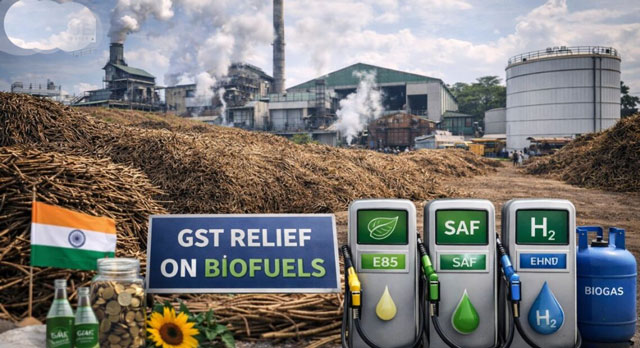
ISMA Director General Deepak Ballani said the government should incentivise advanced biofuels such as Sustainable Aviation Fuel (SAF), green hydrogen and Isobutanol. He noted that with surplus ethanol availability, a mature production base and vehicle technologies already present in the country, India could achieve a significant reduction in carbon emissions.
The association specifically sought a reduction in GST on hydrous ethanol (E85/E100) from the current 18 per cent to 5 per cent. It also recommended that GST on ethanol production machinery be reduced to 5 per cent, similar to the concessions extended to the solar energy sector. ISMA said all ethanol-related machinery should be brought under the 5 per cent GST bracket.
Further, ISMA proposed the launch of a Bharat Biofuels Alliance (BBA) to promote innovation, research, policy development and collaboration across the biofuels value chain. The alliance, it said, could help create integrated bio-energy hubs within sugar refineries.
The association also sought a Rs 2,000 crore support fund to enable sugar mills to transform into integrated bio-energy hubs producing first- and second-generation ethanol, compressed biogas (CBG), sustainable aviation fuel, bio-hydrogen, green electricity and other bio-based products.
According to ISMA, such measures would not only strengthen the sugar sector but also accelerate India’s transition towards cleaner fuels and energy security.