Daijiworld Media Network – Gaza City
Gaza City, Mar 12: Severe shortages of cooking gas and fuel in the Gaza Strip have forced thousands of displaced families to rely on open fires made from wood, plastic and scrap materials to prepare food, raising serious health and safety concerns amid the ongoing war.
Among those affected is Islam Dardouna, a 34-year-old mother of three who now lives in a displacement camp in Sheikh Ajleen, Gaza City after her home in Jabalia was destroyed during the conflict that began in October 2023.
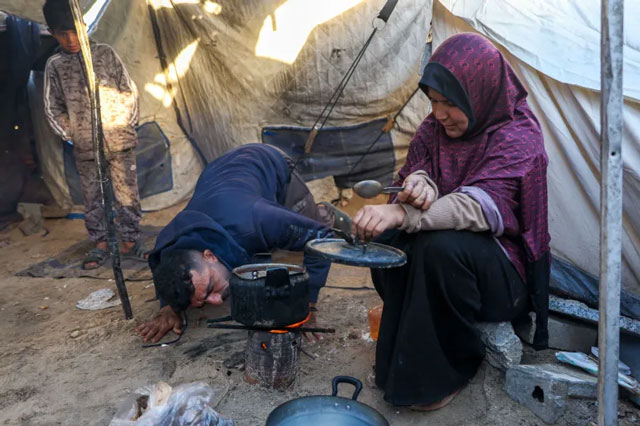
Shortly before the sunset prayer during Ramadan, Dardouna prepares food over a makeshift stove fashioned from a metal can. Paper and small pieces of wood are used as fuel while thick smoke rises from the fire.
Suffering from asthma and chronic chest allergies, she struggles to breathe while cooking and often relies on an inhaler. “I can no longer tolerate the fire,” she said, adding that cooking, heating water and preparing meals over open flames has severely affected her health.
Dardouna said her respiratory problems began during Israel’s 2008 military operation in Gaza after she inhaled smoke from a phosphorus bomb that struck her home. Although her condition had improved over time, it has worsened significantly during the current conflict.
Earlier this year, she was hospitalised for several days due to breathing difficulties and oxygen shortage. Doctors recommended an oxygen cylinder, but the family cannot afford the cost.
Like many displaced residents in Gaza, Dardouna’s family has been forced to move repeatedly since their home was destroyed. She now lives with her husband Muath Dardouna and their children in a temporary camp along with other displaced families.
According to humanitarian agencies, the availability of cooking gas in Gaza remains critically limited despite the announcement of a ceasefire that allowed some supplies to enter the territory.
Data from the United Nations indicates that more than half of Gaza households now rely on firewood for cooking, while many others burn plastic or waste materials due to the absence of gas cylinders. Only a small percentage of families are able to cook using gas.
Aid organisations warn that burning plastic and other waste exposes people to toxic fumes, posing serious health risks and environmental hazards.
The crisis has become even more difficult during Ramadan, when families traditionally prepare meals before dawn and after sunset.
Muath Dardouna said the family often struggles even to light a fire due to wind and rain. As a result, they sometimes skip the pre-dawn meal entirely.
“Every part of our life is suffering,” he said. “Fetching water is difficult, cooking is difficult, and even the simplest things have become a struggle.”
The situation is similar across displacement camps in Gaza. Many families now depend on ready-made food distributed by aid groups, as cooking has become increasingly difficult.
Amani Aed al-Bashleqi, a 26-year-old displaced woman living in a nearby tent, said the smoke from open fires causes headaches and breathing problems for many women in the camp.
“The fire suffocates you,” she said, adding that families have no alternative due to the absence of cooking gas.
Another displaced resident, Iman Junaid, a mother of six, said her family collects plastic bottles to burn for fuel because wood has become expensive and gas cylinders are unavailable.
She acknowledged the health risks but said there is no other option. “Our life now is collecting plastic and burning it to cook,” she said, adding that even her young daughter suffers from chest pain due to smoke inhalation.
The General Petroleum Authority in Gaza has warned that the continued suspension of cooking gas supplies could lead to serious consequences for the territory’s more than two million residents.
Officials said the shortage threatens food security and public health, particularly during Ramadan, and called on international mediators to ensure the regular entry of cooking gas into Gaza.
For many families like the Dardounas, however, the issue goes beyond fuel shortages.
“What we really need is a life that is possible again,” Dardouna said. “Let gas enter, let goods enter, and let people live a normal life.”