Daijiworld Media Network - Chennai
Chennai, May 10: In a landmark political development in Chennai, actor-turned-politician C. Joseph Vijay officially assumed office as the Chief Minister of Tamil Nadu on Sunday and announced a series of immediate welfare and governance measures shortly after taking oath.
Following the swearing-in ceremony at the Jawaharlal Nehru Indoor Stadium, Vijay signed his first official files in the presence of senior bureaucrats and cabinet ministers. Among the first major announcements of the new government were 200 units of free electricity for households and the creation of the “SingaPen” Special Task Force, aimed at strengthening women’s safety and related initiatives.
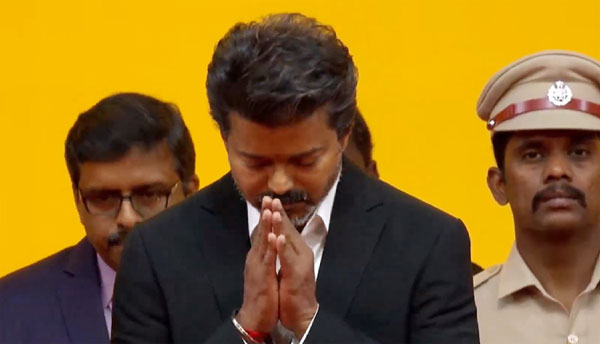
Vijay was administered the oath of office and secrecy by Governor Rajendra Vishwanath Arlekar amid loud celebrations from supporters, party workers, and fans gathered at the venue. He took the oath in the name of C. Joseph Vijay.
His party, Tamilaga Vettri Kazhagam, emerged as the single largest force in the recently concluded Tamil Nadu Assembly elections, securing 108 seats in the 234-member Assembly. Although short of the majority mark, the party formed the government with support from the Indian National Congress and several alliance partners including the CPI, CPI(M), VCK, and IUML, taking the coalition’s strength to 120 legislators.
The swearing-in event saw tight security arrangements across the city, with thousands attending through restricted-entry passes. Senior police officials supervised extensive deployment around the stadium and surrounding areas.
Several prominent political leaders and film personalities were present at the ceremony, including Leader of Opposition Rahul Gandhi, alliance leaders, members of Vijay’s family, and figures from the Tamil film industry.
Alongside Vijay, several ministers were sworn into the new cabinet, marking the formal beginning of the TVK-led administration. The transition is being viewed as a major political shift in Tamil Nadu, signalling the emergence of a new leadership era after decades dominated by the state’s traditional Dravidian parties.