
The Bombay High Court has drawn a clear line on how far statutory maternity protection extends for women employed on ad-hoc or fixed-term contracts, ruling that benefits under the Maternity Benefit Act cannot survive the natural expiry of the underlying employment.
What the Bombay High Court Decided
The case, Somaiya Vidyavihar's K.J. Somaiya College versus the Assistant Commissioner of Labour and the Appellate Authority under the Maternity Benefit Act, 1961, involved an assistant professor employed on an ad-hoc contractual basis at an aided college.The judgment has direct implications for contractual staff across colleges and universities, and it also highlights why maternity insurance is worth considering for employees whose job security is tied to a fixed term rather than a permanent post. The court, in its judgment delivered on 13 July 2026, held that maternity benefits are not available once the contractual term of employment has expired, if that expiry occurs before the maternity leave itself would have commenced.
The bench framed the decisive question clearly: what matters is not whether the employee's status was ad-hoc or permanent, but whether an employer-employee relationship existed on the date maternity leave was set to begin. In this case, the employee's appointment ended through the natural passage of time on 30 April 2024, under the terms governing her contractual role. The court found no evidence on record suggesting the contract was cut short or terminated because of her pregnancy, which meant Section 12 of the Maternity Benefit Act, which protects women from dismissal during maternity leave, was not triggered.
Why This Ruling Matters
This decision sits within a broader and still-evolving body of case law on how maternity protections apply to contractual and ad-hoc staff in India. Earlier rulings from other High Courts, including the Delhi High Court's decision in the Dr. Krati Mehrotra case, had taken a more employee-favorable position, holding that if conception occurs during the tenure of a contract, maternity benefits should extend even if the leave period spills beyond the contract's original end date. The Supreme Court's 2023 ruling in Dr. Kavita Yadav further reinforced that fixed-term employees are entitled to full maternity benefits under the Act, even after their contractual term ends, provided the pregnancy and related eligibility conditions were established during employment.
The Bombay High Court's more recent ruling narrows this protection specifically to situations where the employer-employee relationship was still active on the date the maternity leave was due to start. If the contract had already lapsed by that date, through natural expiry rather than a pregnancy-related termination, the statutory obligation does not apply. This distinction matters because it shifts the analysis from when conception occurred to whether an active employment relationship existed at the point leave was meant to begin.
Comparing the Legal Positions
Recent judicial decisions have interpreted maternity benefit provisions differently, particularly in cases involving contractual or fixed-term employees. Comparing these rulings helps illustrate how courts have balanced statutory protections with employment contracts, while also highlighting the areas where legal uncertainty continues to exist.
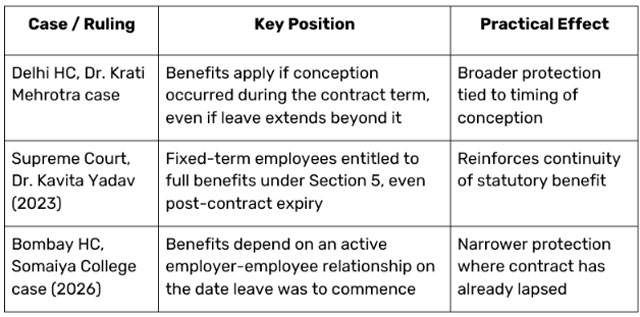
This table shows why institutions and contractual employees alike will need to watch how these differing High Court positions eventually get reconciled, either through further appellate clarification or a fresh Supreme Court ruling specific to this fact pattern.
What This Means for Ad-hoc and Contractual Employees
For women working on ad-hoc or fixed-term contracts in academic institutions, and in similar sectors that rely heavily on contractual staffing, this ruling is a reminder that statutory protection is not automatic once a contract's natural end date arrives. The timing of when a contract expires relative to when maternity leave would begin has now become a materially important factor in whether Section 12 protections apply.
This gap is exactly where private maternity insurance becomes relevant. Since statutory benefits under the Maternity Benefit Act are tied to an active employment relationship, an employee whose contract lapses shortly before her leave was due to start may find herself without either job protection or an automatic right to paid leave. A personal maternity insurance policy, purchased independently of employment status, does not depend on whether a contract is still active; it pays out based on the terms of the policy itself, offering a layer of financial protection that survives a change in job status.
How Maternity Insurance Fills the Gap
Employer-provided maternity benefits, whether through a company health policy or statutory leave entitlements, are generally tied to continuous, active employment. Contractual and ad-hoc staff, by the nature of their work arrangements, face periodic gaps in this coverage every time a contract lapses and a new one is signed, or is delayed in renewal.
A standalone health insurance, bought independently, works differently. It typically covers the cost of delivery, pre- and post-natal care, and sometimes newborn care, based on the policy's own waiting period and terms, regardless of the policyholder's current employment contract status. For women in fields with a high proportion of fixed-term roles, such as academia, research, and certain healthcare positions, this kind of coverage offers continuity that statutory or employer-linked benefits cannot always guarantee, particularly in light of rulings like the one from the Bombay High Court.
Points Worth Reviewing Before Relying on Employer Coverage Alone
Given the uncertainty highlighted by this judgment, contractual employees may want to review a few specific points rather than assuming maternity benefits will automatically apply:
- Contract renewal timing relative to expected delivery dates, since a gap between contracts could affect eligibility under the current legal interpretation.
- Whether the employer's maternity benefit terms extend beyond the contract period, or strictly end when the contract does.
- Availability of independent maternity insurance as a supplement, particularly for those on repeated short-term contracts.
- Documentation of the employment relationship, since the Bombay High Court's ruling placed weight on whether the contract was curtailed for pregnancy-related reasons or simply expired on schedule.
Until the legal position becomes more settled, contractual employees should review both their employment agreements and applicable maternity benefit policies well in advance of their expected leave. Taking proactive steps and seeking clarification from employers can help reduce uncertainty and ensure they are better prepared if questions about eligibility arise.
Final Thoughts
The Bombay High Court's ruling in the Somaiya College case narrows the scope of statutory maternity protection for ad-hoc and contractual employees, tying eligibility closely to whether an active employment relationship exists on the date leave is due to begin. For women in contract-heavy sectors, this makes the case for treating maternity insurance as an independent safeguard rather than relying solely on statutory or employer-linked protection, since a policy purchased on personal terms does not lapse the moment a fixed-term contract does.